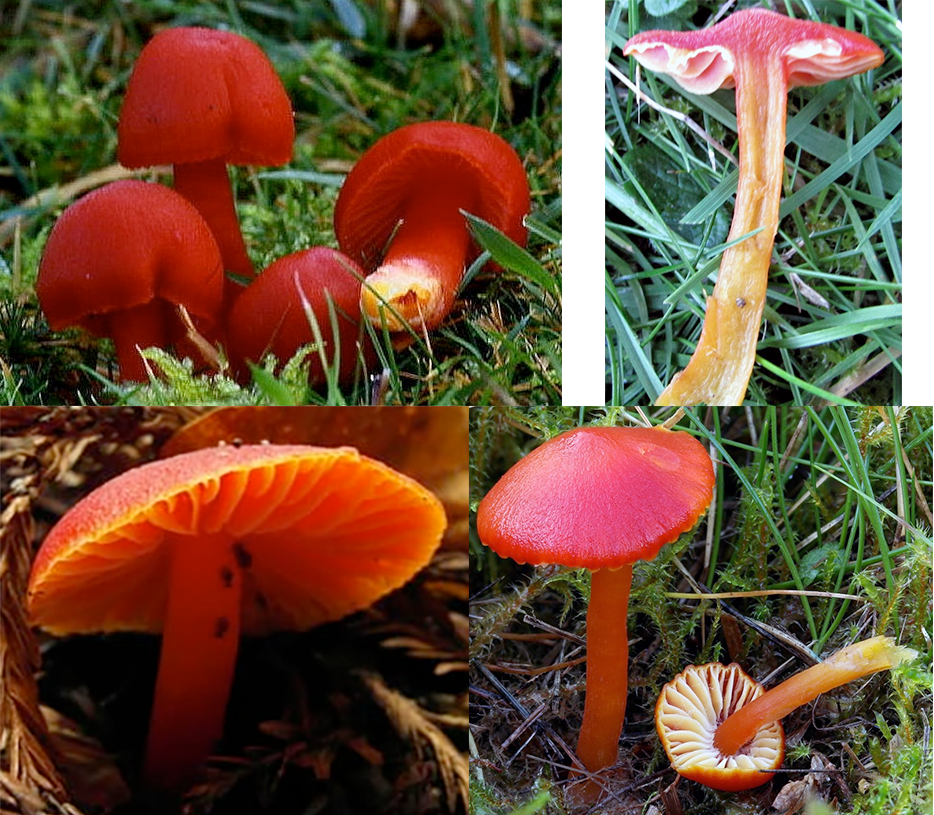
 The image, above, shows an image of Scarlet Waxcap (Hygrocybe
coccinea) showing a cluster of five in moss, a large cap
form in leaf litter, a large form with an inverted specimen besit
it showing the stipe and gills and one scarlet waxcap sliced in
half..
| Common Name: Scarlet Waxcap |
| Scientific Name: Hygrocybe coccinea |
| Other Names: Scarlet Hood, Righteous Red Waxy Cap, Cap Cwyr Coch (CY) |
| Family: Hygrophoraceae |
| Range: Northen Hemisphere |
Physical Characteristics Hygrocybe coccinea is a moss-associated fungus, growing to 12.5cm (5 in) in diameter and 15cm (6 in) tall. It is typically associated with mossy ground in mature pastureland or gardens. This mushroom fruits between August and December, but is most commonly found between September and October.
|
| Edible Parts: Caps and Stipes |
 Spore Print: white Spore Print: white
|
  Cap: Umbonate or Depressed Cap: Umbonate or Depressed
|
 Hymenium: Decurrent Hymenium: Decurrent
|
 Gills: Gills on hymenium Gills: Gills on hymenium
|
 Stipe: Bare Stipe: Bare
|
 Edibility Rating: 5 Edibility Rating: 5 
|
 Known Hazards: None Known. Known Hazards: None Known.
|
Monthly Availability:
|
Welcome to the summary page for FabulousFusionFood's Wild Food guide to Scarlet Waxcap along with all the Scarlet Waxcap containing recipes presented on this site, with 0 recipes in total.
These recipes, all contain Scarlet Waxcap as a major wild food ingredient.
Scarlet Waxcap, Hygrocybe coccinea (also known as Buffcap, Meadow Waxy Cap, Salmon Waxy Cap and Butter Meadowcap) represents a species of agaric (having a pileus [cap] that is clearly differentiated from the stipe [stalk]) fungus that is microrhizal in ecology. This is a small waxcap with an initially bell-shaped, and later flattening, cap 2–5 centimetres (3⁄4–2 in) across, scarlet in colour and slimy in texture. The adnate gills are thick and widely spaced, yellow red in colour. The ringless stipe is 2–5 cm tall and 0.3–1 cm (1⁄8–3⁄8 in) wide, red with a yellowish base. The flesh is yellowish-red and the smell and taste faint. The oval spores measure 7–9.5 x 4–5 μm and produce a white spore print. Hygrocybe coccinea has a wide distribution in unimproved grasslands across Europe from August to October.[2] In Britain, like all Hygrocybes, it has its best seasons in frost-free late autumn months, and in western North America it may be found under redwoods or in mixed woodland in winter.
The scarlet waxcap has a cap that is initially conical/bell-shaped, can open to convex or flatten with age. Starting deep scarlet but fading to orange/red/yellow. It is typically 1-6cm in diameter. The gills start orange/red becoming yellow to cream with age. Broadly joined to stem (adnate) with a small decurrent tooth. Not crowded. The stem is 2-7 cm long, 0.3-0.8 cm diameter. Scarlet to orange red, yellowing slightly towards the base. Hollow. The flesh is red or concolourous with the outside of the mushroom. It can be found in fields, meadows, heaths, open woodland, grasslands, lawn and roadsides but they prefer land that has not been fertilised, treated with chemicals or ploughed.
Possible Confusion:
The Crimson Waxcap (Hygrocybe punicea) as it can accumulate the heavy metal cadmium, it's best avoided; or the Splendid Waxcap (Hygrocybe splendidissima); as an endangered species, this should not be collected. The Crimson Waxcap (Hygrocybe punicea) is larger and has a thicker stem and mainly white flesh, the Splendid Waxcap (Hygrocybe splendidissima) has an irregular, wavy, flattened stem; as another species that accumulates cadmium, it should be avoided. The Blackening Waxcap (Hygrocybe conica) blackens on cutting or with age (this species' toxicity is unknown, but it's considered unsubstantial and best avoided).
Though generally not a highly sought after mushroom, Hygrocybe coccinea is edible but unsubstantial though it does add a splash of colour to the plate. It should, however be noted that on an Europe-wide scale waxcap fungi are now quite rare, and so although in western Britain many of the acid-soil species are still plentiful most mycologists deplore the suggestion of these lovely fungi being gathered to eat. In any case most waxcaps are insubstantial and it is uncertain whether they are safe to eat.
For other edible mushrooms, see the guide to edible mushrooms.
[2]. Huxley, A. The New RHS Dictionary of Gardening. 1999
[3]. Tanaka, T. Tanaka's Cyclopaedia of Edible Plants of the World.
[4]. Lim T.K. Edible Medicinal And Non-Medicinal Plants, Vols 1–12.
[5]. Thomas, G. S. Perennial Garden Plants, 2004
[6]. Milner, E. Trees of Britain and Ireland, 2011
[7]. Rose, F. & O'Reilly, C. The Wild Flower Key (Revised Edition) — How to identify wild plants, trees and shrubs in Britain and Ireland, 2006
[8]. Streeter, D. & Garrard, I. The Wild Flowers of the British Isles, 1983
[9]. Clapham, A.R.; Tutin, T.G. & Moore, D.M. Flora of the British Isles, 1987
[10]. Phillips, R. Mushrooms, 2006
[11]. Jordan, P. & Wheeler, S. The Complete Book of Mushrooms: An Illustrated Encyclopedia of Edible Mushrooms, 2011
[12]. Bunker, F. Seaweeds of Britain and Ireland, Second Edition, 2017
[13]. Facciola, S. Cornucopia II — A Source Book of Edible Plants, 1998
[14]. Hartford, R. Edible and Medicinal Wild Plants of Britain and Ireland: A Foraging and Photographic Identification Guide
(Note that the above book links are Amazon Affiliate links)
These recipes, all contain Scarlet Waxcap as a major wild food ingredient.
Scarlet Waxcap, Hygrocybe coccinea (also known as Buffcap, Meadow Waxy Cap, Salmon Waxy Cap and Butter Meadowcap) represents a species of agaric (having a pileus [cap] that is clearly differentiated from the stipe [stalk]) fungus that is microrhizal in ecology. This is a small waxcap with an initially bell-shaped, and later flattening, cap 2–5 centimetres (3⁄4–2 in) across, scarlet in colour and slimy in texture. The adnate gills are thick and widely spaced, yellow red in colour. The ringless stipe is 2–5 cm tall and 0.3–1 cm (1⁄8–3⁄8 in) wide, red with a yellowish base. The flesh is yellowish-red and the smell and taste faint. The oval spores measure 7–9.5 x 4–5 μm and produce a white spore print. Hygrocybe coccinea has a wide distribution in unimproved grasslands across Europe from August to October.[2] In Britain, like all Hygrocybes, it has its best seasons in frost-free late autumn months, and in western North America it may be found under redwoods or in mixed woodland in winter.
The scarlet waxcap has a cap that is initially conical/bell-shaped, can open to convex or flatten with age. Starting deep scarlet but fading to orange/red/yellow. It is typically 1-6cm in diameter. The gills start orange/red becoming yellow to cream with age. Broadly joined to stem (adnate) with a small decurrent tooth. Not crowded. The stem is 2-7 cm long, 0.3-0.8 cm diameter. Scarlet to orange red, yellowing slightly towards the base. Hollow. The flesh is red or concolourous with the outside of the mushroom. It can be found in fields, meadows, heaths, open woodland, grasslands, lawn and roadsides but they prefer land that has not been fertilised, treated with chemicals or ploughed.
Possible Confusion:
The Crimson Waxcap (Hygrocybe punicea) as it can accumulate the heavy metal cadmium, it's best avoided; or the Splendid Waxcap (Hygrocybe splendidissima); as an endangered species, this should not be collected. The Crimson Waxcap (Hygrocybe punicea) is larger and has a thicker stem and mainly white flesh, the Splendid Waxcap (Hygrocybe splendidissima) has an irregular, wavy, flattened stem; as another species that accumulates cadmium, it should be avoided. The Blackening Waxcap (Hygrocybe conica) blackens on cutting or with age (this species' toxicity is unknown, but it's considered unsubstantial and best avoided).
Though generally not a highly sought after mushroom, Hygrocybe coccinea is edible but unsubstantial though it does add a splash of colour to the plate. It should, however be noted that on an Europe-wide scale waxcap fungi are now quite rare, and so although in western Britain many of the acid-soil species are still plentiful most mycologists deplore the suggestion of these lovely fungi being gathered to eat. In any case most waxcaps are insubstantial and it is uncertain whether they are safe to eat.
For other edible mushrooms, see the guide to edible mushrooms.
References:
[1]. David Evans Notes from field observations, tastings and cookery experiments.[2]. Huxley, A. The New RHS Dictionary of Gardening. 1999
[3]. Tanaka, T. Tanaka's Cyclopaedia of Edible Plants of the World.
[4]. Lim T.K. Edible Medicinal And Non-Medicinal Plants, Vols 1–12.
[5]. Thomas, G. S. Perennial Garden Plants, 2004
[6]. Milner, E. Trees of Britain and Ireland, 2011
[7]. Rose, F. & O'Reilly, C. The Wild Flower Key (Revised Edition) — How to identify wild plants, trees and shrubs in Britain and Ireland, 2006
[8]. Streeter, D. & Garrard, I. The Wild Flowers of the British Isles, 1983
[9]. Clapham, A.R.; Tutin, T.G. & Moore, D.M. Flora of the British Isles, 1987
[10]. Phillips, R. Mushrooms, 2006
[11]. Jordan, P. & Wheeler, S. The Complete Book of Mushrooms: An Illustrated Encyclopedia of Edible Mushrooms, 2011
[12]. Bunker, F. Seaweeds of Britain and Ireland, Second Edition, 2017
[13]. Facciola, S. Cornucopia II — A Source Book of Edible Plants, 1998
[14]. Hartford, R. Edible and Medicinal Wild Plants of Britain and Ireland: A Foraging and Photographic Identification Guide
(Note that the above book links are Amazon Affiliate links)
The alphabetical list of all Scarlet Waxcap recipes on this site follows, (limited to 100 recipes per page). There are 0 recipes in total:
Page 1 of 1
Page 1 of 1