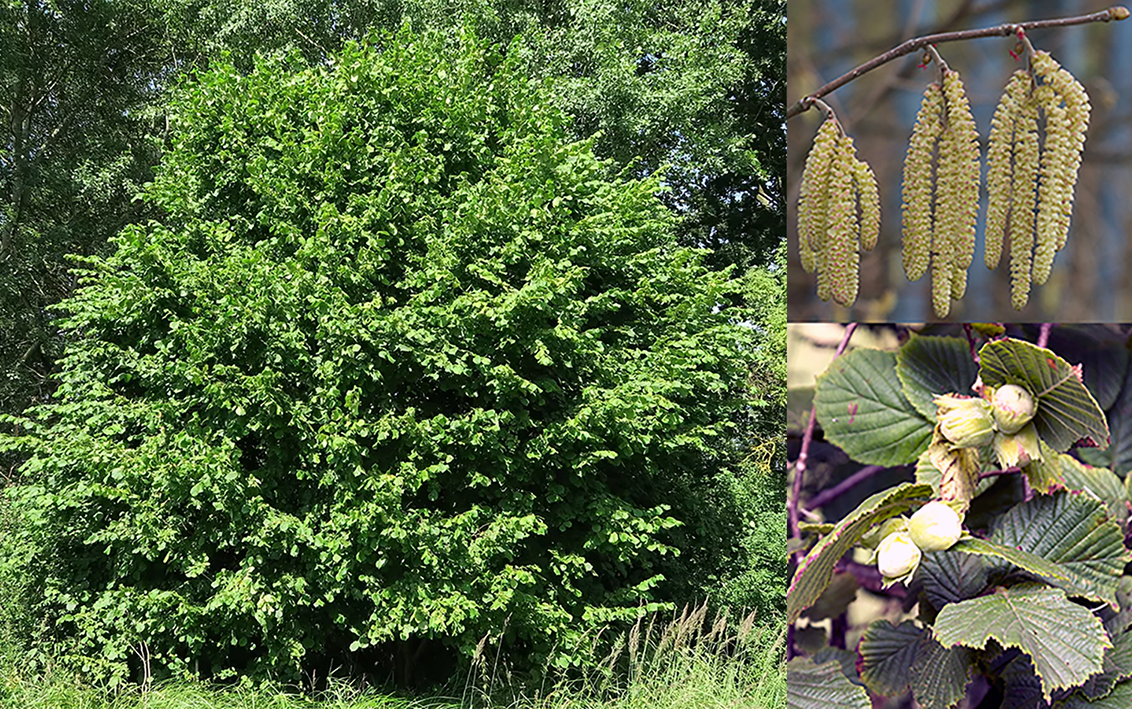
 The image, above, shows the full hazel tree (Corylus
avellana), left, with the male flowers (catkins) top right
and the hazelnuts bottom, right..
| Common Name: Hazel |
| Scientific Name: Corylus avellana |
| Other Names: Cobnut, Hazel, Harry Lauder's Walking Stick, Corkscrew Hazel, Hazelnut |
| Family: Betulaceae |
| Range: Europe, including Britain, from Norway to Spain and east to W. Asia |
Physical Characteristics Corylus avellana is a hardy deciduous tree, growing to 6m (19 ft) by 3m (9 ft) in size. It is hardy to zone 4 and is not frost tender. The plant flowers from January to April and the seeds ripen from September to October. The flowers are monoecious (only one sex per flower), though both sexes can be found on a single tree, and are wind pollinated. The plant is not self-fertile.
|
|
Edible Parts: Nuts, Young Leaves, Catkins (male flowers), Pollen |
 Edibility Rating: 4 Edibility Rating: 4 
|
 Known Hazards: None Known. Known Hazards: None Known.
|
Monthly Availability:
|
Welcome to the summary page for FabulousFusionFood's Wild Food guide to Hazel along with all the Hazel containing recipes presented on this site, with 119 recipes in total.
These recipes, all contain Hazel as a major wild food ingredient.
The Common Hazel, Corylus avellana, (also known as Cobnut, Hazel, Common filbert, European Filbert, Harry Lauder's Walking Stick, Corkscrew Hazel, Hazelnut) is a species of hazel and a member of the Betulaceae (beech) family. This deciduous shrub (which rarely grows more that 7m tall) is native to Europe and Asia. It bears dark green leaves that are rounded, 6–12 cm long and across, softly hairy on both surfaces, and with a double-serrate margin. It is the hazel that bears the classic catkins (also known as 'lambs' tails' of early spring (though these can appear any time from December to April. The plant is monoecious (ie bears separate male and female flowers on the same plant) with the female flowers being very small and largely concealed in the buds, with only the bright red 1-3 mm long styles visible. The fruit is a true nut, produced in clusters of one to five with each nut held in a leafy husk (an involucre) that encloses up to 3/4 of the nut. The nut falls from the involucre when ripe (generally in October) some eight months after pollination. In reality, as wildlife also love hazelnuts you are in competition with a range of species to collect when ripe. You can pick them when they’re green and leave them to ripen in a warm, dry, dark place, like an airing cupboard. Remember to move them often and remove the hard outer shell before eating.
The common hazel is an important component of traditional hedgerows where they were interleaved to form impenetrable boundaries to domestic livestock. The wood was also traditionally grown as a coppice with poles used for wattle-and-daub housing as well as for agricultural fencing. Common Hazel is cultivated for its nuts in commercial orchards in Turkey, Europe, China and Australia. This hazelnut or cobnut, the kernel of the seed, is edible and used raw or roasted, or ground into a paste. When collecting your own clean with a dry cloth and leave the nuts in their shells, they will then keep over winter and only need to be cracked open for use. Hazelnuts work well in both sweet (pralines and chocolate) or savory dishes (they can be used in salads, stews and even make a flour if roasted and ground). They also make a refreshing drink if ground in a blender and mixed with milk. In the 15th century the leaves were used to make a highly-spiced pork stew called 'Noteye' (literally 'nutty', a recipe derived from HARLEIAN MS 279 c 1420; see the links below for the recipe).
I can personally attest that the pollen (which can be collected throughout March and April) is edible and if you have three or four trees nearby is worth foraging for and can be used as a flour additive to increase the protein content. It works well in pancakes, muffins, cakes, biscuits and even bread. To collect, place a bag over several catkins on a sunny day and shake them to release the pollen. You should get a visible cloud. Repeat until you've collected enough to cook with. The male flowers or catkins are also edible (just) they contain about 20% protein, mostly from the pollen and pollen cells but need to be treated with an osmotic agent (sugar!) to break down the cell walls and make them more digestible. They can be used in the preparation of both sweet savoury dishes and, even better they're out and mature from later February through early March when not many other edibles are available.
The hazelnut is delicious eaten raw or cooked, though for children they are more digestible if toasted or roasted first. The nuts can be ground to a flour and this can be used in the same way as ground almonds for preparing breads, cakes, biscuits and sweets (candies). The nuts can also be liquidized in water to make hazelnut milk. Pressing the nuts yields a clear, yellow, edible oil which is excellent used in salad dressings or as an oil in baking and cake making.
[2]. Huxley, A. The New RHS Dictionary of Gardening. 1999
[3]. Tanaka, T. Tanaka's Cyclopaedia of Edible Plants of the World.
[4]. Lim T.K. Edible Medicinal And Non-Medicinal Plants, Vols 1–12.
[5]. Thomas, G. S. Perennial Garden Plants, 2004
[6]. Milner, E. Trees of Britain and Ireland, 2011
[7]. Rose, F. & O'Reilly, C. The Wild Flower Key (Revised Edition) — How to identify wild plants, trees and shrubs in Britain and Ireland, 2006
[8]. Streeter, D. & Garrard, I. The Wild Flowers of the British Isles, 1983
[9]. Clapham, A.R.; Tutin, T.G. & Moore, D.M. Flora of the British Isles, 1987
[10]. Phillips, R. Mushrooms, 2006
[11]. Jordan, P. & Wheeler, S. The Complete Book of Mushrooms: An Illustrated Encyclopedia of Edible Mushrooms, 2011
[12]. Bunker, F. Seaweeds of Britain and Ireland, Second Edition, 2017
[13]. Facciola, S. Cornucopia II — A Source Book of Edible Plants, 1998
[14]. Hartford, R. Edible and Medicinal Wild Plants of Britain and Ireland: A Foraging and Photographic Identification Guide
(Note that the above book links are Amazon Affiliate links)
These recipes, all contain Hazel as a major wild food ingredient.
The Common Hazel, Corylus avellana, (also known as Cobnut, Hazel, Common filbert, European Filbert, Harry Lauder's Walking Stick, Corkscrew Hazel, Hazelnut) is a species of hazel and a member of the Betulaceae (beech) family. This deciduous shrub (which rarely grows more that 7m tall) is native to Europe and Asia. It bears dark green leaves that are rounded, 6–12 cm long and across, softly hairy on both surfaces, and with a double-serrate margin. It is the hazel that bears the classic catkins (also known as 'lambs' tails' of early spring (though these can appear any time from December to April. The plant is monoecious (ie bears separate male and female flowers on the same plant) with the female flowers being very small and largely concealed in the buds, with only the bright red 1-3 mm long styles visible. The fruit is a true nut, produced in clusters of one to five with each nut held in a leafy husk (an involucre) that encloses up to 3/4 of the nut. The nut falls from the involucre when ripe (generally in October) some eight months after pollination. In reality, as wildlife also love hazelnuts you are in competition with a range of species to collect when ripe. You can pick them when they’re green and leave them to ripen in a warm, dry, dark place, like an airing cupboard. Remember to move them often and remove the hard outer shell before eating.
The common hazel is an important component of traditional hedgerows where they were interleaved to form impenetrable boundaries to domestic livestock. The wood was also traditionally grown as a coppice with poles used for wattle-and-daub housing as well as for agricultural fencing. Common Hazel is cultivated for its nuts in commercial orchards in Turkey, Europe, China and Australia. This hazelnut or cobnut, the kernel of the seed, is edible and used raw or roasted, or ground into a paste. When collecting your own clean with a dry cloth and leave the nuts in their shells, they will then keep over winter and only need to be cracked open for use. Hazelnuts work well in both sweet (pralines and chocolate) or savory dishes (they can be used in salads, stews and even make a flour if roasted and ground). They also make a refreshing drink if ground in a blender and mixed with milk. In the 15th century the leaves were used to make a highly-spiced pork stew called 'Noteye' (literally 'nutty', a recipe derived from HARLEIAN MS 279 c 1420; see the links below for the recipe).
I can personally attest that the pollen (which can be collected throughout March and April) is edible and if you have three or four trees nearby is worth foraging for and can be used as a flour additive to increase the protein content. It works well in pancakes, muffins, cakes, biscuits and even bread. To collect, place a bag over several catkins on a sunny day and shake them to release the pollen. You should get a visible cloud. Repeat until you've collected enough to cook with. The male flowers or catkins are also edible (just) they contain about 20% protein, mostly from the pollen and pollen cells but need to be treated with an osmotic agent (sugar!) to break down the cell walls and make them more digestible. They can be used in the preparation of both sweet savoury dishes and, even better they're out and mature from later February through early March when not many other edibles are available.
The hazelnut is delicious eaten raw or cooked, though for children they are more digestible if toasted or roasted first. The nuts can be ground to a flour and this can be used in the same way as ground almonds for preparing breads, cakes, biscuits and sweets (candies). The nuts can also be liquidized in water to make hazelnut milk. Pressing the nuts yields a clear, yellow, edible oil which is excellent used in salad dressings or as an oil in baking and cake making.
References:
[1]. David Evans Notes from field observations, tastings and cookery experiments.[2]. Huxley, A. The New RHS Dictionary of Gardening. 1999
[3]. Tanaka, T. Tanaka's Cyclopaedia of Edible Plants of the World.
[4]. Lim T.K. Edible Medicinal And Non-Medicinal Plants, Vols 1–12.
[5]. Thomas, G. S. Perennial Garden Plants, 2004
[6]. Milner, E. Trees of Britain and Ireland, 2011
[7]. Rose, F. & O'Reilly, C. The Wild Flower Key (Revised Edition) — How to identify wild plants, trees and shrubs in Britain and Ireland, 2006
[8]. Streeter, D. & Garrard, I. The Wild Flowers of the British Isles, 1983
[9]. Clapham, A.R.; Tutin, T.G. & Moore, D.M. Flora of the British Isles, 1987
[10]. Phillips, R. Mushrooms, 2006
[11]. Jordan, P. & Wheeler, S. The Complete Book of Mushrooms: An Illustrated Encyclopedia of Edible Mushrooms, 2011
[12]. Bunker, F. Seaweeds of Britain and Ireland, Second Edition, 2017
[13]. Facciola, S. Cornucopia II — A Source Book of Edible Plants, 1998
[14]. Hartford, R. Edible and Medicinal Wild Plants of Britain and Ireland: A Foraging and Photographic Identification Guide
(Note that the above book links are Amazon Affiliate links)
The alphabetical list of all Hazel recipes on this site follows, (limited to 100 recipes per page). There are 119 recipes in total:
Page 1 of 2
| Étendre chocolat et noisettes (Chocolate and Hazelnut Spread) Origin: France | Dulcia Piperata (Peppered Sweets) Origin: Roman | Ius in Siluro, in Pelamyde et in Thynno Salsis (Sauce for Salt Sheatfish, Young Tuna, or Tuna Over a Year Old) Origin: Roman |
| Acorn and Hazelnut Pap Origin: Ancient | Egg Noodles with Hazel Pollen Origin: Britain | Ius in thynno elixo (Salt Tuna with Sauce) Origin: Roman |
| Ad Aves Hircosas Omni Genere (How to Prepare 'High' Birds of Any Kind) Origin: Roman | Fonio Bread Origin: Fusion | Jerusalem Artichoke and Kale Gratin Origin: Britain |
| Advieh Baklava Origin: Iran | Gastris (Nut Cake) Origin: Roman | Johannisbeerkuchen (German Redcurrant Cake) Origin: Germany |
| Afrikanisches Pistaziendessert (African-style Pistachio Dessert) Origin: Namibia | Gâteau du Matin Breton (Breton Morning Cake) Origin: France | La Torta Tre Monti (Sammarinese Three Mountain Cake) Origin: San Marino |
| Aliter Avem (Birds, Another Way) Origin: Roman | Good Luck Chilli Biscuits Origin: Fusion | Leftover Porridge Muffins Origin: Scotland |
| Aliter Ius Frigidum in Aprum Elixum (Cold Sauce for Boiled Wild Boar, Another Way) Origin: Roman | Haselnußtorte (Hazelnut Torte) Origin: Germany | Lentil and Hazelnut Burgers Origin: Britain |
| Aliter Ius in Avibus (Sauce for Birds, Another Way) Origin: Roman | Haselnuss Halbmonde (Hazelnut Crescent Biscuits) Origin: Germany | Leporem Farsum (Stuffed Hare) Origin: Roman |
| Aliter Ius in Mugile Salso (Another Sauce for Salted Grey Mullet) Origin: Roman | Hawthorn and Nut Autumn Biscuits Origin: Britain | Linguine with saffron, roasted garlic, herb butter and hazelnuts Origin: Britain |
| Amaretto Hazelnut Macaroon Cheesecake Origin: Britain | Hazel Pollen Bread Origin: France | Masfouf bin Narine (Couscous and Nut Dessert) Origin: Tunisia |
| Apple and Cottage Cheese Muffins (Äppelmuffins med KESO) Origin: Sweden | Hazel Pollen Noodles Origin: Fusion | Medlar and Honey Fool Origin: Britain |
| Apple, Pear and Cinnamon Crumble Origin: Britain | Hazel Pollen Pancakes Origin: Britain | Mincemeat Blondies Origin: Fusion |
| Apricot Pinwheels Origin: Britain | Hazel Pollen Waffles Origin: Britain | Mini Mincemeat and Cranberry Loaves Origin: Britain |
| Bara Brith Hydref (Autumnal Bara Brith) Origin: Welsh | Hazelnut and Cowberry Cake Origin: Canada | Mixtura cum Nucibus (Hazelnuts with Herb Purée) Origin: Roman |
| Barbecued Plum and Nut Stuffed Pork Chops Origin: British | Hazelnut and Garlic Mustard Pesto Origin: Britain | Mochi Doughnuts Origin: Hawaii |
| Blackberry Fool with Hazelnut Biscuits Origin: Britain | Hazelnut and Wild Greens Pesto Origin: Britain | Noteye (Nutty) Origin: England |
| Brithyll Mewn Crwst Cnau Cyll â Pherlysiau (Trout in a Hazelnut Crust with Herbs) Origin: Welsh | Hazelnut Brittle Origin: Britain | Nougat Traditionelle (Traditional Nougat) Origin: France |
| Candied Catkins, Catkin Flour and Catkin Syrup Origin: Britain | Hazelnut Clusters Origin: Britain | Nusszopf (German Nut Braid with Marzipan) Origin: Namibia |
| Catkin Crumb Biscuits Origin: Britain | Hazelnut crêpes with caramelised bananas Origin: Britain | Nut Cutlet Origin: British |
| Catkin Crumb Coating Origin: Britain | Hazelnut Crescents Origin: Turkmenistan | Nutella Swirl Banana Muffins Origin: Britain |
| Catkin Crumb Pancakes Origin: Britain | Hazelnut Cupcakes Origin: Britain | Oatmeal Bilberry Bread Origin: Northern Ireland |
| Catkin Crumb Suya Chicken Wings Origin: African Fusion | Hazelnut Halva Origin: Fusion | Orange Mincemeat Origin: Britain |
| Catkin Spicy Avocado Bites Origin: Britain | Hazelnut Meringue Origin: British | Oxeye Daisy Filo Rolls Origin: Fusion |
| Celtic Pork and Apple Stew Origin: Ancient | Hazelnut Milk Origin: Britain | Panforte Origin: Italy |
| Chicken Liver and Raisin Pâté Origin: South Africa | Hazelnut Nougat Origin: Britain | Panforte II Origin: Italy |
| Chocolate Banana Smoothie Origin: American | Hazelnut Pancakes Origin: Britain | Pangiallo romano (Roman Christmas Cake) Origin: Italy |
| Chocolate Meringue Cupcakes Origin: Britain | Heather Biscotti Origin: Scotland | Pangiallo romano (Roman Christmas Cake) Origin: Vatican City |
| Chocolate Panforte Origin: Italy | Hedgerow Jam Origin: British | Pastai Briwgig Eidion a Nionod (Leek and Caerphilly Cheese Crumble Tart) Origin: Welsh |
| Cobnut Stuffing for Goose Origin: Britain | Hedgerow Salad Origin: Ancient | Peli Rwm Nadolig (Christmas Rum Balls) Origin: Welsh |
| Cobnut, Pear and Sticky Toffee Tart Origin: England | Honey and Catkin Grain Biscuits Origin: Britain | Pisam Farsilem (Pressed Peas) Origin: Roman |
| Collumella's Moretum Origin: Roman | Ius Candidum in Ansere Elixo (White Sauce for Boiled Goose) Origin: Roman | Pomegranate Lokum (Pomegranate Turkish Delight) Origin: Turkey |
| Damson and Cobnut Mincemeat Origin: Britain | Ius Candidum in Avem Elixam (White Sauce for a Boiled Bird) Origin: Roman | Pullum Numidicum (Numidian Guinea Fowl) Origin: Roman |
| Dobos Torte II (Drum Cake II) Origin: Hungary | Ius in Cervo (Sauce for Venison) Origin: Roman | |
| Dukkah Origin: Egypt | Ius in Mugile Salso (Sauce for Salted Grey Mullet) Origin: Roman |
Page 1 of 2