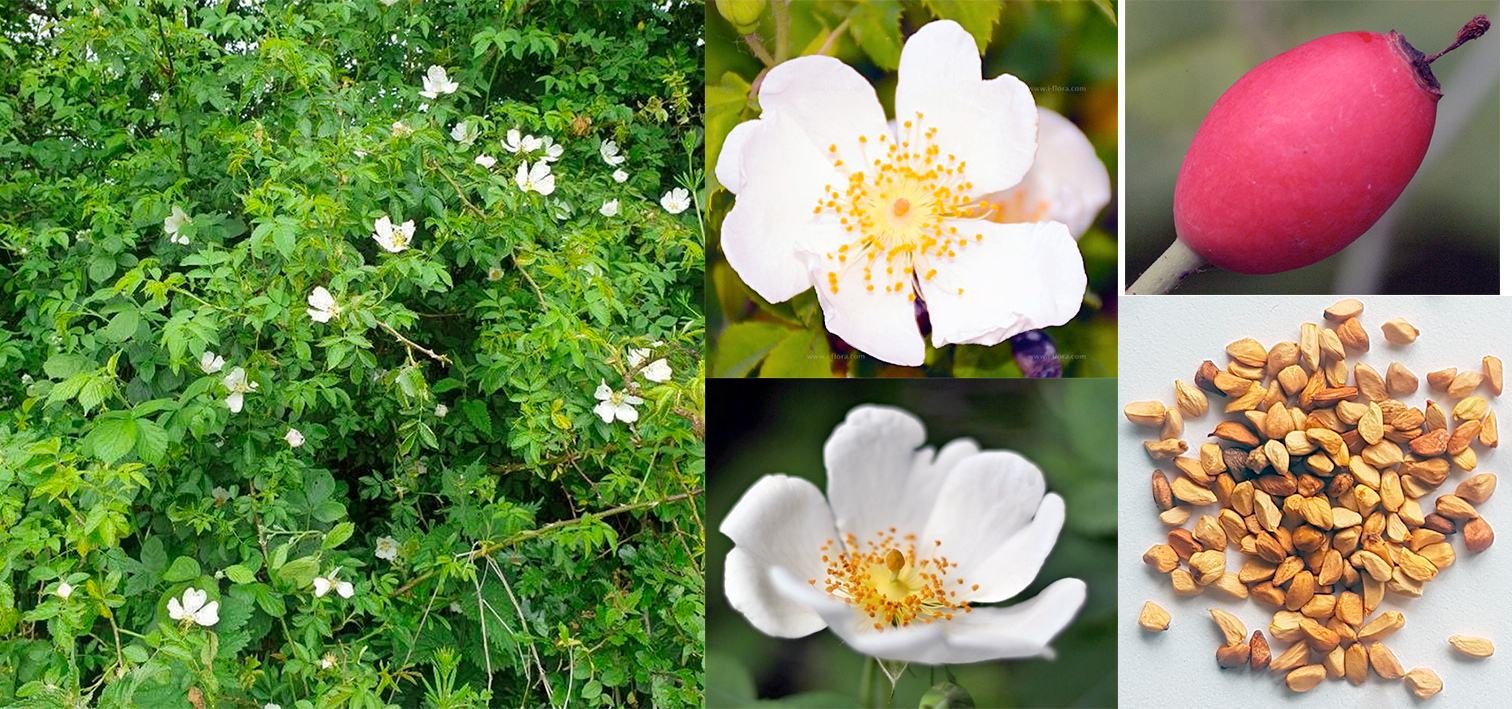
 The image, above, shows the full field rose plant (Rosa
arvensis), left. Also shown are close-ups of the flower
(centre) along with the mature hip (right top) and the seeds
after processing to remove the hairs..
|
Common Name: Field Rose |
| Scientific Name: Rosa arvensis |
|
Other Names: white-flowered trailing rose |
| Family: Rosaceae |
| Range: Western, Central and Southern Europe, including Britain. |
Physical Characteristics Rosa arvensis is a deciduous shrub, growing to 3.7m tall. It is hardy to zone 3 and is not frost tender. The plant flowers from during July and the fruit ripen from October to December. The flowers are hermaphrodite and are pollinated by bees, flies, beetles and lepidoptera. The plant is self-fertile and is noted for attracting wildlife.
|
| Edible Parts: Flowers, Fruit, Seed, Leaves |
 Edibility Rating: 3 Edibility Rating: 3 
|
 Known Hazards: Though no part of the plant is toxic per se the seeds, which are found just underneath the flesh of the fruit are covered by fine hairs that can cause irritation to the mouth and digestive tract if ingested. Known Hazards: Though no part of the plant is toxic per se the seeds, which are found just underneath the flesh of the fruit are covered by fine hairs that can cause irritation to the mouth and digestive tract if ingested.
|
Monthly Availability: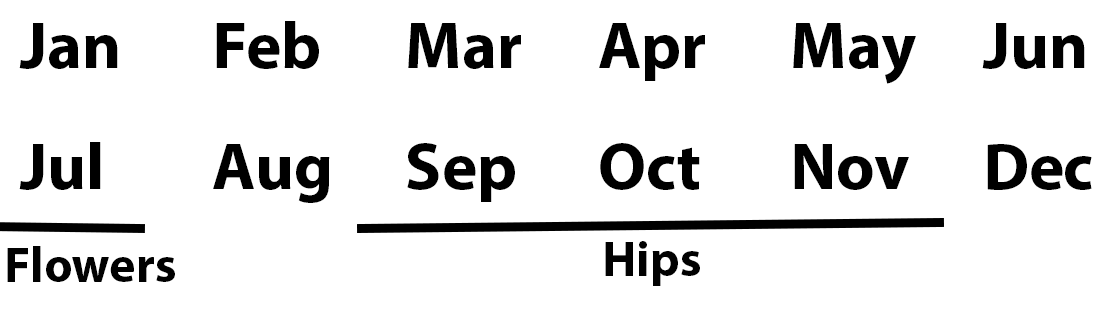
|
Welcome to the summary page for FabulousFusionFood's Wild Food guide to Field Rose along with all the Field Rose containing recipes presented on this site, with 0 recipes in total.
These recipes, all contain Field Rose as a major wild food ingredient.
The Field Rose, Rosa arvensis, (also known as the white-flowered trailing rose) is a deciduous shrub that was first identified in England and which is native to Western, Central and Southern Europe. It is a rambling shrub that ranges in height from 3–.7m. Its flowers are white, 4 to 5 centimetres across, and its fruits ('hips') are red. It blooms in the summer (July in the UK). Rosa arvensis is a vigorous, thorny, rambling shrub with long arching or scrambling purple stems and slightly fragrant, single creamy-white flowers produced in one flush in midsummer, followed by oval orange-red hips.
Like the dog rose petals and hips of the field rose can be consumed. The petals have a subtler scent that those of garden roses and are excellent served neat in salads. They can also be crystallized in sugar and can be made into rose petal wine. Rose petals are also one of the standard flavourings of Turkish Delights. Field Rose petals also make a very interesting jelly and can be made into jams if used with rhubarb or fruit such as greengages. Rose-petal jam is very popular in the Middle East and is generally eaten with yoghurt.
Rose hips have a very high vitamin C content and they can be used to make rose-hip syrup which was popularized during the Second World War when other sources of Vitamin C were scarce. Rose-hip syrup still represents one of the few examples of a wild foodstuff resulting in a commercial product. You can still make rose-hip syrup at home however and it remains one of the simplest ways of removing the internal seeds of the rose-hip whose furry coating can be a digestive irritant. In the Middle Ages rose hips were even used as a dessert where the rose-hips were halved and the seeds and pith removed. The resulting skins were stored in an earthenware pot until they were sufficiently soft to be passed through a sieve. The resultant purée was then mixed with equal mass of sugar before being heated until the sugar melted. This was then used as a pie filling. Rose-hips can also be made into an infusion as rose-hip tea and can be converted into marmalade.
The seeds of the plant are edible, a long as all the irritant hairs are removed by blanching and then rubbing in a cloth. Indeed, the seeds are an excellent dietary source of vitamin E. Once prepared the seeds should be ground, toasted in the oven then ground to a powder. This powder can be used as a flour substitute, or as a flour adulterant. It can also be used as an additive to other foods to supplement vitamin E levels.
The dried leaves are used as a tea substitute or can be ground as a coffee substitute. The young leaves can also be collected and cooked as a vegetable.
[2]. Huxley, A. The New RHS Dictionary of Gardening. 1999
[3]. Tanaka, T. Tanaka's Cyclopaedia of Edible Plants of the World.
[4]. Lim T.K. Edible Medicinal And Non-Medicinal Plants, Vols 1–12.
[5]. Thomas, G. S. Perennial Garden Plants, 2004
[6]. Milner, E. Trees of Britain and Ireland, 2011
[7]. Rose, F. & O'Reilly, C. The Wild Flower Key (Revised Edition) — How to identify wild plants, trees and shrubs in Britain and Ireland, 2006
[8]. Streeter, D. & Garrard, I. The Wild Flowers of the British Isles, 1983
[9]. Clapham, A.R.; Tutin, T.G. & Moore, D.M. Flora of the British Isles, 1987
[10]. Phillips, R. Mushrooms, 2006
[11]. Jordan, P. & Wheeler, S. The Complete Book of Mushrooms: An Illustrated Encyclopedia of Edible Mushrooms, 2011
[12]. Bunker, F. Seaweeds of Britain and Ireland, Second Edition, 2017
[13]. Facciola, S. Cornucopia II — A Source Book of Edible Plants, 1998
[14]. Hartford, R. Edible and Medicinal Wild Plants of Britain and Ireland: A Foraging and Photographic Identification Guide
(Note that the above book links are Amazon Affiliate links)
These recipes, all contain Field Rose as a major wild food ingredient.
The Field Rose, Rosa arvensis, (also known as the white-flowered trailing rose) is a deciduous shrub that was first identified in England and which is native to Western, Central and Southern Europe. It is a rambling shrub that ranges in height from 3–.7m. Its flowers are white, 4 to 5 centimetres across, and its fruits ('hips') are red. It blooms in the summer (July in the UK). Rosa arvensis is a vigorous, thorny, rambling shrub with long arching or scrambling purple stems and slightly fragrant, single creamy-white flowers produced in one flush in midsummer, followed by oval orange-red hips.
Like the dog rose petals and hips of the field rose can be consumed. The petals have a subtler scent that those of garden roses and are excellent served neat in salads. They can also be crystallized in sugar and can be made into rose petal wine. Rose petals are also one of the standard flavourings of Turkish Delights. Field Rose petals also make a very interesting jelly and can be made into jams if used with rhubarb or fruit such as greengages. Rose-petal jam is very popular in the Middle East and is generally eaten with yoghurt.
Rose hips have a very high vitamin C content and they can be used to make rose-hip syrup which was popularized during the Second World War when other sources of Vitamin C were scarce. Rose-hip syrup still represents one of the few examples of a wild foodstuff resulting in a commercial product. You can still make rose-hip syrup at home however and it remains one of the simplest ways of removing the internal seeds of the rose-hip whose furry coating can be a digestive irritant. In the Middle Ages rose hips were even used as a dessert where the rose-hips were halved and the seeds and pith removed. The resulting skins were stored in an earthenware pot until they were sufficiently soft to be passed through a sieve. The resultant purée was then mixed with equal mass of sugar before being heated until the sugar melted. This was then used as a pie filling. Rose-hips can also be made into an infusion as rose-hip tea and can be converted into marmalade.
The seeds of the plant are edible, a long as all the irritant hairs are removed by blanching and then rubbing in a cloth. Indeed, the seeds are an excellent dietary source of vitamin E. Once prepared the seeds should be ground, toasted in the oven then ground to a powder. This powder can be used as a flour substitute, or as a flour adulterant. It can also be used as an additive to other foods to supplement vitamin E levels.
The dried leaves are used as a tea substitute or can be ground as a coffee substitute. The young leaves can also be collected and cooked as a vegetable.
References:
[1]. David Evans Notes from field observations, tastings and cookery experiments.[2]. Huxley, A. The New RHS Dictionary of Gardening. 1999
[3]. Tanaka, T. Tanaka's Cyclopaedia of Edible Plants of the World.
[4]. Lim T.K. Edible Medicinal And Non-Medicinal Plants, Vols 1–12.
[5]. Thomas, G. S. Perennial Garden Plants, 2004
[6]. Milner, E. Trees of Britain and Ireland, 2011
[7]. Rose, F. & O'Reilly, C. The Wild Flower Key (Revised Edition) — How to identify wild plants, trees and shrubs in Britain and Ireland, 2006
[8]. Streeter, D. & Garrard, I. The Wild Flowers of the British Isles, 1983
[9]. Clapham, A.R.; Tutin, T.G. & Moore, D.M. Flora of the British Isles, 1987
[10]. Phillips, R. Mushrooms, 2006
[11]. Jordan, P. & Wheeler, S. The Complete Book of Mushrooms: An Illustrated Encyclopedia of Edible Mushrooms, 2011
[12]. Bunker, F. Seaweeds of Britain and Ireland, Second Edition, 2017
[13]. Facciola, S. Cornucopia II — A Source Book of Edible Plants, 1998
[14]. Hartford, R. Edible and Medicinal Wild Plants of Britain and Ireland: A Foraging and Photographic Identification Guide
(Note that the above book links are Amazon Affiliate links)
The alphabetical list of all Field Rose recipes on this site follows, (limited to 100 recipes per page). There are 0 recipes in total:
Page 1 of 1
Page 1 of 1