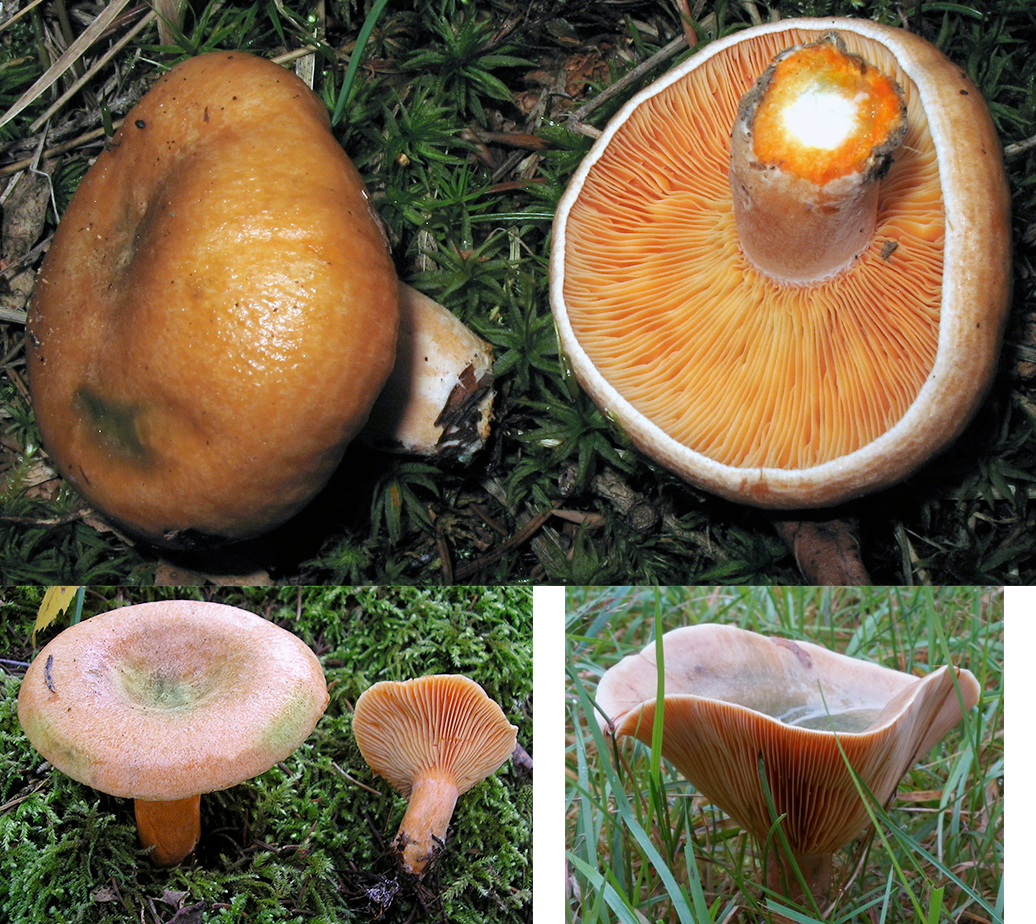
 The image, above, shows an image of Saffron Milk Cap
(Lactarius deterrimus) showing the whole mushroom in
three stages of its growth from the closed cap, open cap and
mature trumpet form. Also shown are two versions on their sides
showing the saffron gills and the saffron staining of the cut
stem..
| Common Name: False Saffron Milk Cap |
| Scientific Name: Lactarius deterrimus |
| Other Names: Orange Milkcap, Spruce Milkcap, Cap Llaeth Saffrwm Ffug (CY) |
| Family: Russulaceae |
| Range: It is native to Europe, but has also found in parts of Asia. |
Physical Characteristics Lactarius deterrimus is a mycorrhizal fungus, growing to 12cm in diameter and 6cm (2 1/2 in) tall. It is typically associated with that associates with Norway spruce and bearberry and fruits from July through to November.
|
| Edible Parts: Caps and Stipes |
 Spore Print: Tan Spore Print: Tan
|
 Cap: Depressed Cap: Depressed
|
 Hymenium: Decurrent Hymenium: Decurrent
|
 Gills: Gills on hymenium Gills: Gills on hymenium
|
 Stipe: Bare Stipe: Bare
|
 Edibility Rating: 5 Edibility Rating: 5 
|
 Known Hazards: None Known. Known Hazards: None Known.
|
Monthly Availability:
|
Welcome to the summary page for FabulousFusionFood's Wild Food guide to False Saffron Milk Cap along with all the False Saffron Milk Cap containing recipes presented on this site, with 9 recipes in total.
These recipes, all contain False Saffron Milk Cap as a major wild food ingredient.
False Saffron Milk Cap, Lactarius deterrimus (also known as Orange Milkcap, Spruce Milkcap) is an edible species of mycorrhizal fungus and is a member of the Russulaceae (Russula) family of mushrooms with a tan (pale yellow0 spore print. It is widespread in Europe and is also found in Asia. It a mushroom of pine (particularly spruce) woodland. In the UK, it may be found from July through to November. The cap is 3 to 10cm, rarely up to 12cm wide and more or less centrifugal-shaped and round. It is at early stage convex, furled on the edge, and depressed in the centre. Later it is flat, funnel-shaped, and depressed. The cap skin is bare, greasy in moist weather and slightly shiny when dry. The cap is tangerine to orange-brown, darker zoned towards the edges and dulls mainly yellow-brown. In old age or after cold or frost it changes the colour more or less to dirty greenish or green-spotted.
The dense, bow-like lamellae are pale-orange to pale-ochre and on the stipe basifixed or slightly decurrent. They are brittle and intermixed with shorter lamellulae (short gills that do not extend fully from the cap margin to the stem) as well as partly forking near the stem. In old age or in cases of injury they receive initially dark red, later grey green spots. The spore print is pale ochre.
The mainly long and cylindrical stipe is reddish orange. It is 4 to 8cm (rarely 10cm) long, 1 to 1.5cm wide and barely foveate or blotchy. On the basis it is often slightly thickened or pompous and becomes hollow inside. A bloomy circular zones is found on the lamella disposition.
The milk is first carrot-red and becomes a maroon colour within 10 to 30 minutes. The brittle and pale-yellowish flesh is often infested with maggots. If cut or injured it becomes, as the milk, first carrot-red, then maroon and within hours dirty green. The fruit body smells harsh, fruit-like and first tastes mild, but then slightly resinous-bitter and nearly spicy or somewhat astringent.
Lactarius deterrimus is an edible mushroom, but is much less appreciated than the similar. The first tastes slightly bitter and is often infested by maggots. Like L. deliciosus, this fungus is mainly stir-fried in butter or oil; if it is cooked in water, the flesh becomes very soft. Young fruit bodies can be also pickled, or dried for later use. As the fungus is often heavily infested by maggots, skilled mushroom pickers prefer young fruit bodies. The urine discolours to red if a large amount of milk caps are eaten, but this is entirely harmless and is not evidence for an impairment to health. The red-coloured azulene compounds, ingested with the mushroom food, are more or less excreted with the urine.
Possible confusion: The likewise very common (and choice edible) Lactarius deliciosus is similar in appearance. Lactarius deterrimus differs basically from the first because its flesh becomes reddish within 10 minutes and in about 30 minutes dark maroon, caused by the discolouration of the milk. The milk of L. deliciosus stays orange or becomes reddish within 30 minutes. Also, the milk of the latter tastes mild, while the milk of the first distinctly bitter. The cap of L. deterrimus changes its colour in old age or if injured distinctly greenish and is common only under spruces, while L. deliciosus is native under pines. Even more similar is the very rare Lactarius semisanguifluus. Its milk also discolours within 5 to 8 minutes to maroon. The cap of older fruit bodies is nearly completely greenish. It is also common under pines. The most similar and also the most closely related fungus is Lactarius fennoscandicus, a boreal to subalpine species. Its cap is distinctly zoned and brown-orange. Sometimes the cap has purple-grey tones. The stem is pale to blunt orange-ochre.
For other edible mushrooms, see the guide to edible mushrooms
[2]. Huxley, A. The New RHS Dictionary of Gardening. 1999
[3]. Tanaka, T. Tanaka's Cyclopaedia of Edible Plants of the World.
[4]. Lim T.K. Edible Medicinal And Non-Medicinal Plants, Vols 1–12.
[5]. Thomas, G. S. Perennial Garden Plants, 2004
[6]. Milner, E. Trees of Britain and Ireland, 2011
[7]. Rose, F. & O'Reilly, C. The Wild Flower Key (Revised Edition) — How to identify wild plants, trees and shrubs in Britain and Ireland, 2006
[8]. Streeter, D. & Garrard, I. The Wild Flowers of the British Isles, 1983
[9]. Clapham, A.R.; Tutin, T.G. & Moore, D.M. Flora of the British Isles, 1987
[10]. Phillips, R. Mushrooms, 2006
[11]. Jordan, P. & Wheeler, S. The Complete Book of Mushrooms: An Illustrated Encyclopedia of Edible Mushrooms, 2011
[12]. Bunker, F. Seaweeds of Britain and Ireland, Second Edition, 2017
[13]. Facciola, S. Cornucopia II — A Source Book of Edible Plants, 1998
[14]. Hartford, R. Edible and Medicinal Wild Plants of Britain and Ireland: A Foraging and Photographic Identification Guide
(Note that the above book links are Amazon Affiliate links)
These recipes, all contain False Saffron Milk Cap as a major wild food ingredient.
False Saffron Milk Cap, Lactarius deterrimus (also known as Orange Milkcap, Spruce Milkcap) is an edible species of mycorrhizal fungus and is a member of the Russulaceae (Russula) family of mushrooms with a tan (pale yellow0 spore print. It is widespread in Europe and is also found in Asia. It a mushroom of pine (particularly spruce) woodland. In the UK, it may be found from July through to November. The cap is 3 to 10cm, rarely up to 12cm wide and more or less centrifugal-shaped and round. It is at early stage convex, furled on the edge, and depressed in the centre. Later it is flat, funnel-shaped, and depressed. The cap skin is bare, greasy in moist weather and slightly shiny when dry. The cap is tangerine to orange-brown, darker zoned towards the edges and dulls mainly yellow-brown. In old age or after cold or frost it changes the colour more or less to dirty greenish or green-spotted.
The dense, bow-like lamellae are pale-orange to pale-ochre and on the stipe basifixed or slightly decurrent. They are brittle and intermixed with shorter lamellulae (short gills that do not extend fully from the cap margin to the stem) as well as partly forking near the stem. In old age or in cases of injury they receive initially dark red, later grey green spots. The spore print is pale ochre.
The mainly long and cylindrical stipe is reddish orange. It is 4 to 8cm (rarely 10cm) long, 1 to 1.5cm wide and barely foveate or blotchy. On the basis it is often slightly thickened or pompous and becomes hollow inside. A bloomy circular zones is found on the lamella disposition.
The milk is first carrot-red and becomes a maroon colour within 10 to 30 minutes. The brittle and pale-yellowish flesh is often infested with maggots. If cut or injured it becomes, as the milk, first carrot-red, then maroon and within hours dirty green. The fruit body smells harsh, fruit-like and first tastes mild, but then slightly resinous-bitter and nearly spicy or somewhat astringent.
Lactarius deterrimus is an edible mushroom, but is much less appreciated than the similar
Possible confusion: The likewise very common (and choice edible) Lactarius deliciosus is similar in appearance. Lactarius deterrimus differs basically from the first because its flesh becomes reddish within 10 minutes and in about 30 minutes dark maroon, caused by the discolouration of the milk. The milk of L. deliciosus stays orange or becomes reddish within 30 minutes. Also, the milk of the latter tastes mild, while the milk of the first distinctly bitter. The cap of L. deterrimus changes its colour in old age or if injured distinctly greenish and is common only under spruces, while L. deliciosus is native under pines. Even more similar is the very rare Lactarius semisanguifluus. Its milk also discolours within 5 to 8 minutes to maroon. The cap of older fruit bodies is nearly completely greenish. It is also common under pines. The most similar and also the most closely related fungus is Lactarius fennoscandicus, a boreal to subalpine species. Its cap is distinctly zoned and brown-orange. Sometimes the cap has purple-grey tones. The stem is pale to blunt orange-ochre.
For other edible mushrooms, see the guide to edible mushrooms
References:
[1]. David Evans Notes from field observations, tastings and cookery experiments.[2]. Huxley, A. The New RHS Dictionary of Gardening. 1999
[3]. Tanaka, T. Tanaka's Cyclopaedia of Edible Plants of the World.
[4]. Lim T.K. Edible Medicinal And Non-Medicinal Plants, Vols 1–12.
[5]. Thomas, G. S. Perennial Garden Plants, 2004
[6]. Milner, E. Trees of Britain and Ireland, 2011
[7]. Rose, F. & O'Reilly, C. The Wild Flower Key (Revised Edition) — How to identify wild plants, trees and shrubs in Britain and Ireland, 2006
[8]. Streeter, D. & Garrard, I. The Wild Flowers of the British Isles, 1983
[9]. Clapham, A.R.; Tutin, T.G. & Moore, D.M. Flora of the British Isles, 1987
[10]. Phillips, R. Mushrooms, 2006
[11]. Jordan, P. & Wheeler, S. The Complete Book of Mushrooms: An Illustrated Encyclopedia of Edible Mushrooms, 2011
[12]. Bunker, F. Seaweeds of Britain and Ireland, Second Edition, 2017
[13]. Facciola, S. Cornucopia II — A Source Book of Edible Plants, 1998
[14]. Hartford, R. Edible and Medicinal Wild Plants of Britain and Ireland: A Foraging and Photographic Identification Guide
(Note that the above book links are Amazon Affiliate links)
The alphabetical list of all False Saffron Milk Cap recipes on this site follows, (limited to 100 recipes per page). There are 9 recipes in total:
Page 1 of 1
| Blodsoppsvampsoppa (Scarletina Bolete Mushroom Soup) Origin: Sweden | Saffron Milk Cap Pâté Origin: Britain | Wild Mushroom Compote Origin: Britain |
| Brine-pickled Mushrooms with Herbs Origin: Britain | Sienimunaskas-kääryle (Wild Mushroom Omelette Roll) Origin: Finland | Wild Mushroom Omelette Origin: Britain |
| Fried Charcoal Burner Mushrooms Origin: Britain | Torta di patate e Funghi selvatici (Wild Mushroom and Potato Cake) Origin: Italy | Wild Mushroom Stuffed Potato Cakes Origin: Britain |
Page 1 of 1