 Evening primrose, Oenothera biennis is a species of
flowering biennial plant in the family Onagraceae, native to
eastern North America. It has been widely naturalized in Britain.
It was first introduced from North America in the 17th century,
being introduced to the new hot houses of the time. Its perfume
and evening flower opening would bring large crows to watch the
plant. Like may introduced plants it was later spread UK-wide by
the railways and is still frequently seen on old railway
embankments..
| Common Name: Evening Primrose |
| Scientific Name: Oenothera biennis |
| Other Names: common evening primrose, evening star, sundrop, weedy evening primrose, German rampion, hog weed, King's cure-all and fever-plant |
| Family: Onagraceae |
| Range: Origin: Evening primrose is native to Eastern North America Eastern N. America its range extending from Labrador, south to Florida and Texas. It has been naturalized in Britain. In Britain it is most commonly found on dunes, roadsides, railway banks and waste places frequently on sandy soils. |
Physical Characteristics Oenothera biennis is a biennial, growing up to 1.2m in height. It is in flower from June to September, and the seeds ripen from August to October. The species is hermaphrodite (has both male and female organs) and is pollinated by Lepidoptera (Moths & Butterflies), bees. The plant is self-fertile. It is noted as a wildlife attractant
Suitable for: light (sandy) and medium (loamy) soils, prefers well-drained soil and can grow in nutritionally poor soil. Suitable pH: mildly acid, neutral and basic (mildly alkaline) soils. It cannot grow in the shade. It prefers dry or moist soil and can tolerate drought.
Oenothera biennis is a biennial, growing up to 1.2m in height. It is in flower from June to September, and the seeds ripen from August to October. The species is hermaphrodite (has both male and female organs) and is pollinated by Lepidoptera (Moths & Butterflies), bees. The plant is self-fertile. It is noted as a wildlife attractant
Suitable for: light (sandy) and medium (loamy) soils, prefers well-drained soil and can grow in nutritionally poor soil. Suitable pH: mildly acid, neutral and basic (mildly alkaline) soils. It cannot grow in the shade. It prefers dry or moist soil and can tolerate drought.
|
| Edible Parts: Flowers, leaves, seeds and seed-pods, shoots, oil |
 Edibility Rating: 3 Edibility Rating: 3 
|
 Known Hazards: Lowers the threshold for epileptic fits (avoid). Caution if on anticoagulants. Combining with phenothiazines (allopathic medication) can trigger seizures. Adverse effects: may cause headaches and nausea on an empty stomach. Diarrhoea with high doses. Seizures in schizophrenic patients on phenothiazines (allergy antihistamines) Known Hazards: Lowers the threshold for epileptic fits (avoid). Caution if on anticoagulants. Combining with phenothiazines (allopathic medication) can trigger seizures. Adverse effects: may cause headaches and nausea on an empty stomach. Diarrhoea with high doses. Seizures in schizophrenic patients on phenothiazines (allergy antihistamines)
|
Monthly Availability: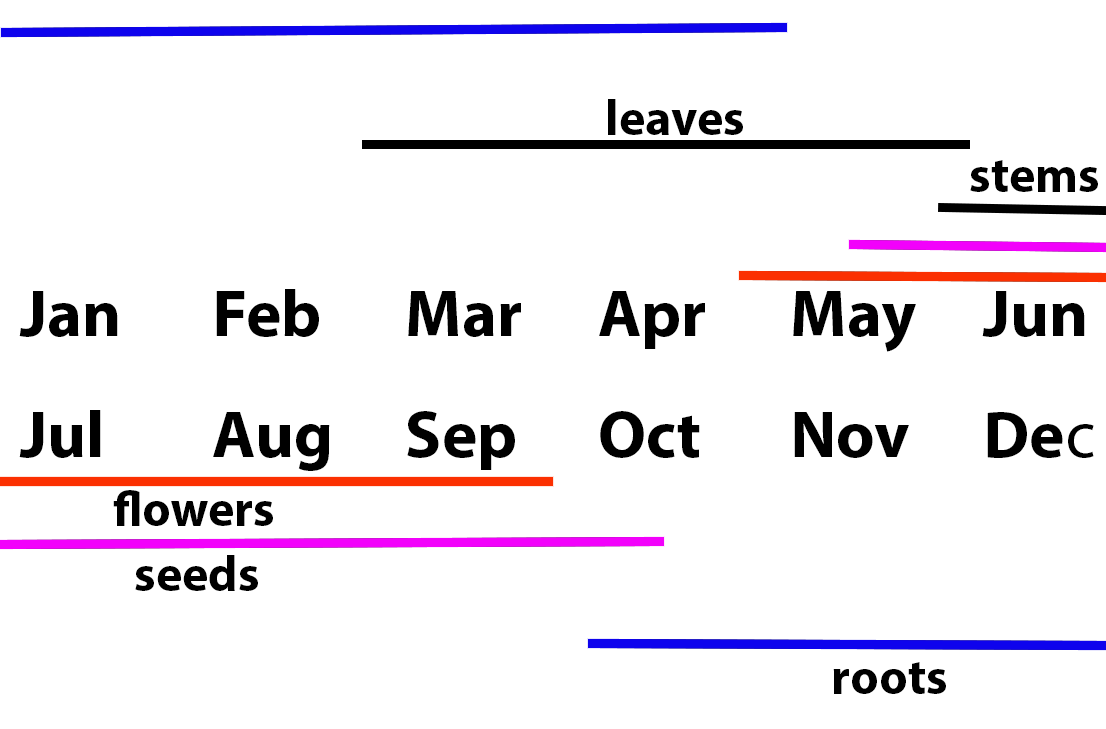
|
Welcome to the summary page for FabulousFusionFood's Wild Food guide to Evening primrose along with all the Evening primrose containing recipes presented on this site, with 8 recipes in total.
These recipes, all contain Evening primrose as a major wild food ingredient.
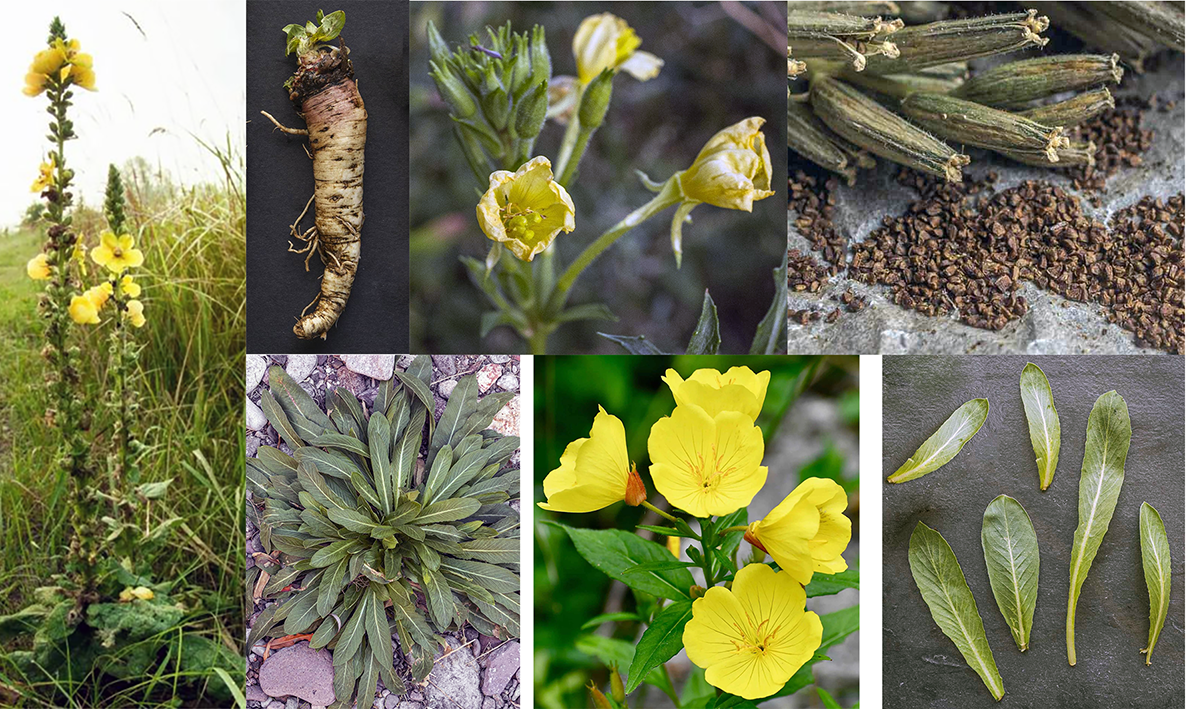
Oenothera biennis usually has a life span of two years (biennial) growing to 1.6 m (5 ft 3 in) tall in the seeding year.[6] The leaves are lanceolate, 8–18 cm (3–7 in) long and 2–6 cm (3⁄4–2+1⁄4 in) wide,[6] produced in a tight rosette the first year, and spirally on a stem the second year. However, plants with annual life cycles are documented, and have been selected for under experimental conditions in environments with low competition.
Most commonly, O. biennis grows as a low, spreading herb in the first year, just a few centimetres tall, with its leaves spreading out in a rosette to cover the ground, whilst storing energy in a thick root. In the second year, it grows up much taller, to around 1.6 metres (5.2 ft) tall, on a semi-woody stem, which then flowers and seeds. This will usually die at first frosts, but occasionally grows another stem in the third year.
Blooming lasts from late spring to late summer. The flowers are hermaphrodite, produced on a tall spike and only last until the following noon. They open visibly fast every evening producing an interesting spectacle, hence the name "evening primrose". The blooms are yellow, 2.5–5 cm (1–2 in) diameter, with four bilobed petals. The flower structure has a bright nectar guide pattern, invisible to the naked eye. This pattern is apparent under ultraviolet light and visible to its pollinators, moths, butterflies, and bees.
The fruit is a capsule 2–4cm long and 4–6mm broad, containing numerous 1–2 mm (0.04–0.08 in) long seeds, released when the capsule splits into four sections at maturity.
Over the centuries, Indigenous people in North America have used the plant as food and traditional medicine. The evening primrose was introduced to Europe in the early 17th century as an ornamental plant in botanical gardens where its flowers are favoured for nectar by pollinators, such as bees, and its seeds are food for birds.
Most of the plant parts are edible, having a taste that is mild. The roots can be eaten raw or cooked like potatoes. The leaves can be eaten raw in salads or cooked like spinach or in soups. Anishinaabe tribes traditionally make tea from the evening primrose leaves for use as a dietary aid and to reduce fatigue. The flowering stems are preferably used when they are still young in June. They have to be peeled and can then be eaten raw or fried. The flower buds are regarded as a delicacy and can be harvested from June to October. oil content of 24%, and contain about 43% cellulose. The proteins are especially rich in the sulphur-containing amino acids, methionine and cysteine, and tryptophan. Gamma-linolenic acid (GLA), and linoleic acid are present. Mainly for these polyunsaturated fatty acids, evening primrose oil is sold as a dietary supplement.
It should be noted that there is insufficient clinical evidence to support the use of evening primrose oil as a therapy for any medical condition.
The common evening primrose is a biennial. This means that in the first year it forms ground-covering leaf rosettes, in the second year a ribbed, slightly bristly stem appears, which can grow up to 1.5 m high. The wrinkled, matt green leaves are elongated oval with pale veins. They can grow up to 20 cm long. Evening primrose leaves can be eaten raw or cooked.
The root of Evening Primrose is best harvested between autumn of the first year and spring of the second year, before it develops the flower spike. It is boiled and eaten like salsify[. It is fleshy, with a sweet and succulent flavour somewhat reminiscent of salsify or parsnips but with a peppery note to the taste. The young shoots can be consumed raw or cooked but are best consumed sparingly (some sources suggest that they should not be eaten but this may refer to older shoots that become fibrous). The flowers taste sweet with jasmine overtones and can be used in salads or as a garnish. Young seedpods are edible and can be steamed to cook. The seed contains 28% of a drying oil. It is edible and a very good source of γ-linolenic acid (GLA), an essential fatty acid that is not found in many plant sources and has numerous vital functions in the body. The seed, however, is very small and difficult to harvest, it has to be done by hand. Overall yields are low, making the oil very expensive to produce. Young leaves are edible in salads, but older leaves become astringent and may have sedative properties.
Though the leaves are technically edible, the stems rapidly overwhelm the leaf and they are best collected early in the plant's first year. It's best to lightly steam them before serving.
[2]. Huxley, A. The New RHS Dictionary of Gardening. 1999
[3]. Tanaka, T. Tanaka's Cyclopaedia of Edible Plants of the World.
[4]. Lim T.K. Edible Medicinal And Non-Medicinal Plants, Vols 1–12.
[5]. Thomas, G. S. Perennial Garden Plants, 2004
[6]. Milner, E. Trees of Britain and Ireland, 2011
[7]. Rose, F. & O'Reilly, C. The Wild Flower Key (Revised Edition) — How to identify wild plants, trees and shrubs in Britain and Ireland, 2006
[8]. Streeter, D. & Garrard, I. The Wild Flowers of the British Isles, 1983
[9]. Clapham, A.R.; Tutin, T.G. & Moore, D.M. Flora of the British Isles, 1987
[10]. Phillips, R. Mushrooms, 2006
[11]. Jordan, P. & Wheeler, S. The Complete Book of Mushrooms: An Illustrated Encyclopedia of Edible Mushrooms, 2011
[12]. Bunker, F. Seaweeds of Britain and Ireland, Second Edition, 2017
[13]. Facciola, S. Cornucopia II — A Source Book of Edible Plants, 1998
[14]. Hartford, R. Edible and Medicinal Wild Plants of Britain and Ireland: A Foraging and Photographic Identification Guide
(Note that the above book links are Amazon Affiliate links)
These recipes, all contain Evening primrose as a major wild food ingredient.
Oenothera biennis usually has a life span of two years (biennial) growing to 1.6 m (5 ft 3 in) tall in the seeding year.[6] The leaves are lanceolate, 8–18 cm (3–7 in) long and 2–6 cm (3⁄4–2+1⁄4 in) wide,[6] produced in a tight rosette the first year, and spirally on a stem the second year. However, plants with annual life cycles are documented, and have been selected for under experimental conditions in environments with low competition.
Most commonly, O. biennis grows as a low, spreading herb in the first year, just a few centimetres tall, with its leaves spreading out in a rosette to cover the ground, whilst storing energy in a thick root. In the second year, it grows up much taller, to around 1.6 metres (5.2 ft) tall, on a semi-woody stem, which then flowers and seeds. This will usually die at first frosts, but occasionally grows another stem in the third year.
Blooming lasts from late spring to late summer. The flowers are hermaphrodite, produced on a tall spike and only last until the following noon. They open visibly fast every evening producing an interesting spectacle, hence the name "evening primrose". The blooms are yellow, 2.5–5 cm (1–2 in) diameter, with four bilobed petals. The flower structure has a bright nectar guide pattern, invisible to the naked eye. This pattern is apparent under ultraviolet light and visible to its pollinators, moths, butterflies, and bees.
The fruit is a capsule 2–4cm long and 4–6mm broad, containing numerous 1–2 mm (0.04–0.08 in) long seeds, released when the capsule splits into four sections at maturity.
Over the centuries, Indigenous people in North America have used the plant as food and traditional medicine. The evening primrose was introduced to Europe in the early 17th century as an ornamental plant in botanical gardens where its flowers are favoured for nectar by pollinators, such as bees, and its seeds are food for birds.
Most of the plant parts are edible, having a taste that is mild. The roots can be eaten raw or cooked like potatoes. The leaves can be eaten raw in salads or cooked like spinach or in soups. Anishinaabe tribes traditionally make tea from the evening primrose leaves for use as a dietary aid and to reduce fatigue. The flowering stems are preferably used when they are still young in June. They have to be peeled and can then be eaten raw or fried. The flower buds are regarded as a delicacy and can be harvested from June to October. oil content of 24%, and contain about 43% cellulose. The proteins are especially rich in the sulphur-containing amino acids, methionine and cysteine, and tryptophan. Gamma-linolenic acid (GLA), and linoleic acid are present. Mainly for these polyunsaturated fatty acids, evening primrose oil is sold as a dietary supplement.
It should be noted that there is insufficient clinical evidence to support the use of evening primrose oil as a therapy for any medical condition.
The common evening primrose is a biennial. This means that in the first year it forms ground-covering leaf rosettes, in the second year a ribbed, slightly bristly stem appears, which can grow up to 1.5 m high. The wrinkled, matt green leaves are elongated oval with pale veins. They can grow up to 20 cm long. Evening primrose leaves can be eaten raw or cooked.
The root of Evening Primrose is best harvested between autumn of the first year and spring of the second year, before it develops the flower spike. It is boiled and eaten like salsify[. It is fleshy, with a sweet and succulent flavour somewhat reminiscent of salsify or parsnips but with a peppery note to the taste. The young shoots can be consumed raw or cooked but are best consumed sparingly (some sources suggest that they should not be eaten but this may refer to older shoots that become fibrous). The flowers taste sweet with jasmine overtones and can be used in salads or as a garnish. Young seedpods are edible and can be steamed to cook. The seed contains 28% of a drying oil. It is edible and a very good source of γ-linolenic acid (GLA), an essential fatty acid that is not found in many plant sources and has numerous vital functions in the body. The seed, however, is very small and difficult to harvest, it has to be done by hand. Overall yields are low, making the oil very expensive to produce. Young leaves are edible in salads, but older leaves become astringent and may have sedative properties.
Though the leaves are technically edible, the stems rapidly overwhelm the leaf and they are best collected early in the plant's first year. It's best to lightly steam them before serving.
References:
[1]. David Evans Notes from field observations, tastings and cookery experiments.[2]. Huxley, A. The New RHS Dictionary of Gardening. 1999
[3]. Tanaka, T. Tanaka's Cyclopaedia of Edible Plants of the World.
[4]. Lim T.K. Edible Medicinal And Non-Medicinal Plants, Vols 1–12.
[5]. Thomas, G. S. Perennial Garden Plants, 2004
[6]. Milner, E. Trees of Britain and Ireland, 2011
[7]. Rose, F. & O'Reilly, C. The Wild Flower Key (Revised Edition) — How to identify wild plants, trees and shrubs in Britain and Ireland, 2006
[8]. Streeter, D. & Garrard, I. The Wild Flowers of the British Isles, 1983
[9]. Clapham, A.R.; Tutin, T.G. & Moore, D.M. Flora of the British Isles, 1987
[10]. Phillips, R. Mushrooms, 2006
[11]. Jordan, P. & Wheeler, S. The Complete Book of Mushrooms: An Illustrated Encyclopedia of Edible Mushrooms, 2011
[12]. Bunker, F. Seaweeds of Britain and Ireland, Second Edition, 2017
[13]. Facciola, S. Cornucopia II — A Source Book of Edible Plants, 1998
[14]. Hartford, R. Edible and Medicinal Wild Plants of Britain and Ireland: A Foraging and Photographic Identification Guide
(Note that the above book links are Amazon Affiliate links)
The alphabetical list of all Evening primrose recipes on this site follows, (limited to 100 recipes per page). There are 8 recipes in total:
Page 1 of 1
| Boiled Evening Primrose Roots Origin: Britain | Pickled Evening Primrose Roots Origin: Britain | Wild Food Stalk Fritters Origin: Britain |
| Evening Primrose Root Gobo (Japanese-style Braised Evening Primrose Root) Origin: Britain | Roasted Autumn Vegetables Origin: Britain | Wild Food Stalks with Garlic and Butter Origin: Britain |
| Pickled Evening Primrose Buds and Flowers Origin: Britain | Toasted Evening Primrose Seeds Origin: Britain |
Page 1 of 1