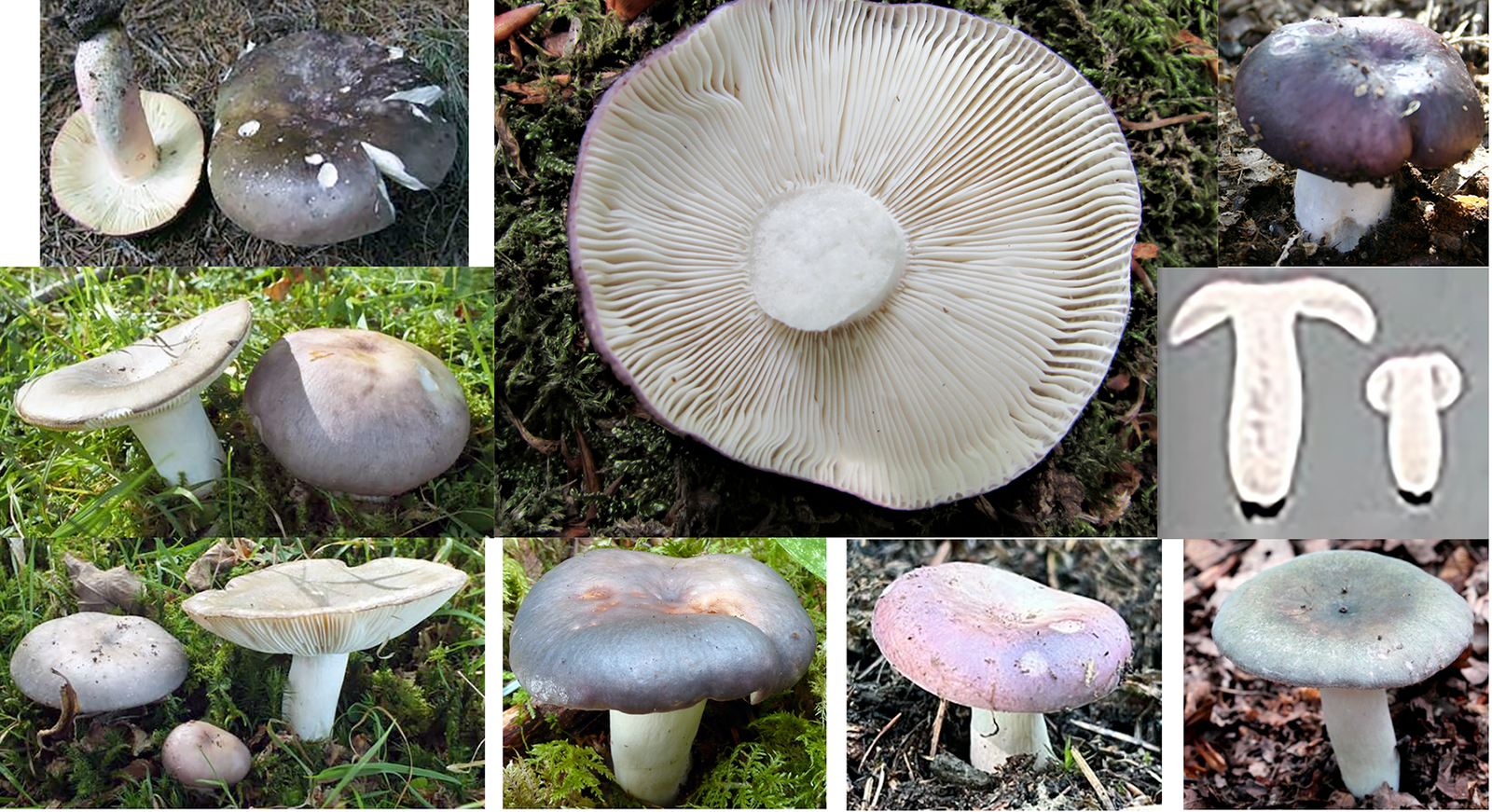
 The image, above, shows an various images of the Charcoal Burner
(Russula cyanoxantha) mushrooms showcasing the
differences in form and colour that can be observed. Centre is an
inverted mushroom, showing the gills. Also shown are two
specimens cut open to reveal the white flesh..
| Common Name: Charcoal Burner |
| Scientific Name: Russula cyanoxantha |
| Other Names: Variegated Russula, Tegyll Brau Dulas (CY) |
| Family: Russulaceae |
| Range: Native to Europe, with North American counterparts, but is possibly found in Europe only. |
Physical Characteristics
 Russula cyanoxantha is s a basidiomycete mushroom, with a cap growing to 4–18cm in diameter and 5#x2013;10 cm tall. It is typically associated with beech woodland (but can be found in other deciduous woodland) and fruits from august to October (but can sometimes be found in July the charcoal burner can be very variable in form and has numerous lookalikes (though all are edible).
|
| Edible Parts: Caps and Stipes |
 Spore Print: White Spore Print: White
|
 Cap: Flat or Convex Cap: Flat or Convex
|
 Hymenium: Adnate Hymenium: Adnate
|
 Pores: Gills on hymenium Pores: Gills on hymenium
|
 Stipe: Bare Stipe: Bare
|
 Edibility Rating: 4 Edibility Rating: 4 
|
 Known Hazards: None known Known Hazards: None known
|
Monthly Availability:
|
Welcome to the summary page for FabulousFusionFood's Wild Food guide to Charcoal Burner along with all the Charcoal Burner containing recipes presented on this site, with 15 recipes in total.
These recipes, all contain Charcoal Burner as a major wild food ingredient.
Charcoal Burner, Russula cyanoxantha (also known as Variegated Russula) is a choice edible species of basidomycete fungus and is a member of the Russulaceae (brittlegill) family of mushrooms with a white spore print. It is widespread in Europe and grows in slightly acidic, but nutrient-rich soil. Like all Russulas, it is a mycorrhizal fungus. It is found most commonly in beech forests (but also associated with oak), and often in deciduous or mixed forests.
The cap is 4–18cm wide, convex at first and later flattened, and greenish to bright brown; they vary considerably in colour. The white-to-cream gills are sometimes forked and are not as brittle as most other members of the genus. The stipe is pure white, slightly convex underneath, from 2.5–12cm in height and 1–5cm in diameter. The most salient characteristic is the weak gills, which feel greasy to the touch, are flexible and do not break.
The spores are white, as is the spore print. Unlike other brittlegills, the stipe does not produce a salmon reaction when rubbed with ferrous sulphate. Indeed, it stains slightly green when rubbed with iron salts. This is a brittle mushroom (apart from its gills), and the reason for its crumbly texture is the high proportion of sphaerocysts - rounded hyphal cells - in the flesh of the mushroom. All members of the Russulacea (and some other families) have sphaerocysts within their fruitbodies, the proportion varying from species to species. In the UK at least, this mushroom never bears a ring on the stipe. Cap colours can be highly variable, from reddish purple to brown and yellow (though fully white caps are not unknown). A common variant, R cyanoxantha var pelteraui has a completely green cap.
The gills are unusually pliable for a brittlegill, densely packed and sometimes forked. he charcoal burner is so named because the caps resemble the colours of burning charcoal, and because they are reminiscent of the ruddy faces of the charcoal burners. The spore print White to pale cream and the spores are broadly elipsoid.
The charcoal burner is an excellent edible spices, particularly when consumed raw. It has a mild, nutty flavour (reminiscent of hazelnuts) that, unfortunately, is also adored by slugs and maggots. The surface of the cap is slightly sticky, especially in damp weather conditions, and tends to attract dirt. Thorough cleaning is therefore required before use. A damp cloth can help to remove most dirt from the cap. However, we usually remove the cap skin entirely respectively as far as it can be removed. In the past, charcoal burners were traditionally roasted on the floors of bread ovens. Today, simply frying in butter remains one of the best ways of preparing them.
Possible confusion: The cap of the grey-green Russula grisea is more blue-grey but has violet or green hues with light cream gills; it also grows in mixed forests, particularly under beech, and more rarely in coniferous forests. Russula olivacea also may have a variegated cap, but produces yellow spores. R. aeruginea is greenish and has forked gills. R. variata is frequently forked and found in the east. R. versicolor has yellowish, unforked gills. Russula xerampelina, which can have a similar cap colour, but has a distinctive fishy odour. There are approximately 160 species of brittlegills (Russula spp.) in the UK, and they can be difficult to identify.
For other edible mushrooms, see the guide to edible mushrooms
[2]. Huxley, A. The New RHS Dictionary of Gardening. 1999
[3]. Tanaka, T. Tanaka's Cyclopaedia of Edible Plants of the World.
[4]. Lim T.K. Edible Medicinal And Non-Medicinal Plants, Vols 1–12.
[5]. Thomas, G. S. Perennial Garden Plants, 2004
[6]. Milner, E. Trees of Britain and Ireland, 2011
[7]. Rose, F. & O'Reilly, C. The Wild Flower Key (Revised Edition) — How to identify wild plants, trees and shrubs in Britain and Ireland, 2006
[8]. Streeter, D. & Garrard, I. The Wild Flowers of the British Isles, 1983
[9]. Clapham, A.R.; Tutin, T.G. & Moore, D.M. Flora of the British Isles, 1987
[10]. Phillips, R. Mushrooms, 2006
[11]. Jordan, P. & Wheeler, S. The Complete Book of Mushrooms: An Illustrated Encyclopedia of Edible Mushrooms, 2011
[12]. Bunker, F. Seaweeds of Britain and Ireland, Second Edition, 2017
[13]. Facciola, S. Cornucopia II — A Source Book of Edible Plants, 1998
[14]. Hartford, R. Edible and Medicinal Wild Plants of Britain and Ireland: A Foraging and Photographic Identification Guide
(Note that the above book links are Amazon Affiliate links)
These recipes, all contain Charcoal Burner as a major wild food ingredient.
Charcoal Burner, Russula cyanoxantha (also known as Variegated Russula) is a choice edible species of basidomycete fungus and is a member of the Russulaceae (brittlegill) family of mushrooms with a white spore print. It is widespread in Europe and grows in slightly acidic, but nutrient-rich soil. Like all Russulas, it is a mycorrhizal fungus. It is found most commonly in beech forests (but also associated with oak), and often in deciduous or mixed forests.
The cap is 4–18cm wide, convex at first and later flattened, and greenish to bright brown; they vary considerably in colour. The white-to-cream gills are sometimes forked and are not as brittle as most other members of the genus. The stipe is pure white, slightly convex underneath, from 2.5–12cm in height and 1–5cm in diameter. The most salient characteristic is the weak gills, which feel greasy to the touch, are flexible and do not break.
The spores are white, as is the spore print. Unlike other brittlegills, the stipe does not produce a salmon reaction when rubbed with ferrous sulphate. Indeed, it stains slightly green when rubbed with iron salts. This is a brittle mushroom (apart from its gills), and the reason for its crumbly texture is the high proportion of sphaerocysts - rounded hyphal cells - in the flesh of the mushroom. All members of the Russulacea (and some other families) have sphaerocysts within their fruitbodies, the proportion varying from species to species. In the UK at least, this mushroom never bears a ring on the stipe. Cap colours can be highly variable, from reddish purple to brown and yellow (though fully white caps are not unknown). A common variant, R cyanoxantha var pelteraui has a completely green cap.
The gills are unusually pliable for a brittlegill, densely packed and sometimes forked. he charcoal burner is so named because the caps resemble the colours of burning charcoal, and because they are reminiscent of the ruddy faces of the charcoal burners. The spore print White to pale cream and the spores are broadly elipsoid.
The charcoal burner is an excellent edible spices, particularly when consumed raw. It has a mild, nutty flavour (reminiscent of hazelnuts) that, unfortunately, is also adored by slugs and maggots. The surface of the cap is slightly sticky, especially in damp weather conditions, and tends to attract dirt. Thorough cleaning is therefore required before use. A damp cloth can help to remove most dirt from the cap. However, we usually remove the cap skin entirely respectively as far as it can be removed. In the past, charcoal burners were traditionally roasted on the floors of bread ovens. Today, simply frying in butter remains one of the best ways of preparing them.
Possible confusion: The cap of the grey-green Russula grisea is more blue-grey but has violet or green hues with light cream gills; it also grows in mixed forests, particularly under beech, and more rarely in coniferous forests. Russula olivacea also may have a variegated cap, but produces yellow spores. R. aeruginea is greenish and has forked gills. R. variata is frequently forked and found in the east. R. versicolor has yellowish, unforked gills. Russula xerampelina, which can have a similar cap colour, but has a distinctive fishy odour. There are approximately 160 species of brittlegills (Russula spp.) in the UK, and they can be difficult to identify.
For other edible mushrooms, see the guide to edible mushrooms
References:
[1]. David Evans Notes from field observations, tastings and cookery experiments.[2]. Huxley, A. The New RHS Dictionary of Gardening. 1999
[3]. Tanaka, T. Tanaka's Cyclopaedia of Edible Plants of the World.
[4]. Lim T.K. Edible Medicinal And Non-Medicinal Plants, Vols 1–12.
[5]. Thomas, G. S. Perennial Garden Plants, 2004
[6]. Milner, E. Trees of Britain and Ireland, 2011
[7]. Rose, F. & O'Reilly, C. The Wild Flower Key (Revised Edition) — How to identify wild plants, trees and shrubs in Britain and Ireland, 2006
[8]. Streeter, D. & Garrard, I. The Wild Flowers of the British Isles, 1983
[9]. Clapham, A.R.; Tutin, T.G. & Moore, D.M. Flora of the British Isles, 1987
[10]. Phillips, R. Mushrooms, 2006
[11]. Jordan, P. & Wheeler, S. The Complete Book of Mushrooms: An Illustrated Encyclopedia of Edible Mushrooms, 2011
[12]. Bunker, F. Seaweeds of Britain and Ireland, Second Edition, 2017
[13]. Facciola, S. Cornucopia II — A Source Book of Edible Plants, 1998
[14]. Hartford, R. Edible and Medicinal Wild Plants of Britain and Ireland: A Foraging and Photographic Identification Guide
(Note that the above book links are Amazon Affiliate links)
The alphabetical list of all Charcoal Burner recipes on this site follows, (limited to 100 recipes per page). There are 15 recipes in total:
Page 1 of 1
| Blodsoppsvampsoppa (Scarletina Bolete Mushroom Soup) Origin: Sweden | Mushroom Gravy Origin: Britain | Torta di patate e Funghi selvatici (Wild Mushroom and Potato Cake) Origin: Italy |
| Brine-pickled Mushrooms with Herbs Origin: Britain | Pickled Bolete Mushrooms Origin: American | Wild Mushroom Compote Origin: Britain |
| Dried Mushrooms Origin: Britain | Pickled Mushrooms Origin: Britain | Wild Mushroom Omelette Origin: Britain |
| Fried Charcoal Burner Mushrooms Origin: Britain | Saffron Milk Cap Pâté Origin: Britain | Wild Mushroom Soup Origin: Britain |
| Mushroom and Sherry Soup Origin: Britain | Sienimunaskas-kääryle (Wild Mushroom Omelette Roll) Origin: Finland | Wild Mushroom Stuffed Potato Cakes Origin: Britain |
Page 1 of 1