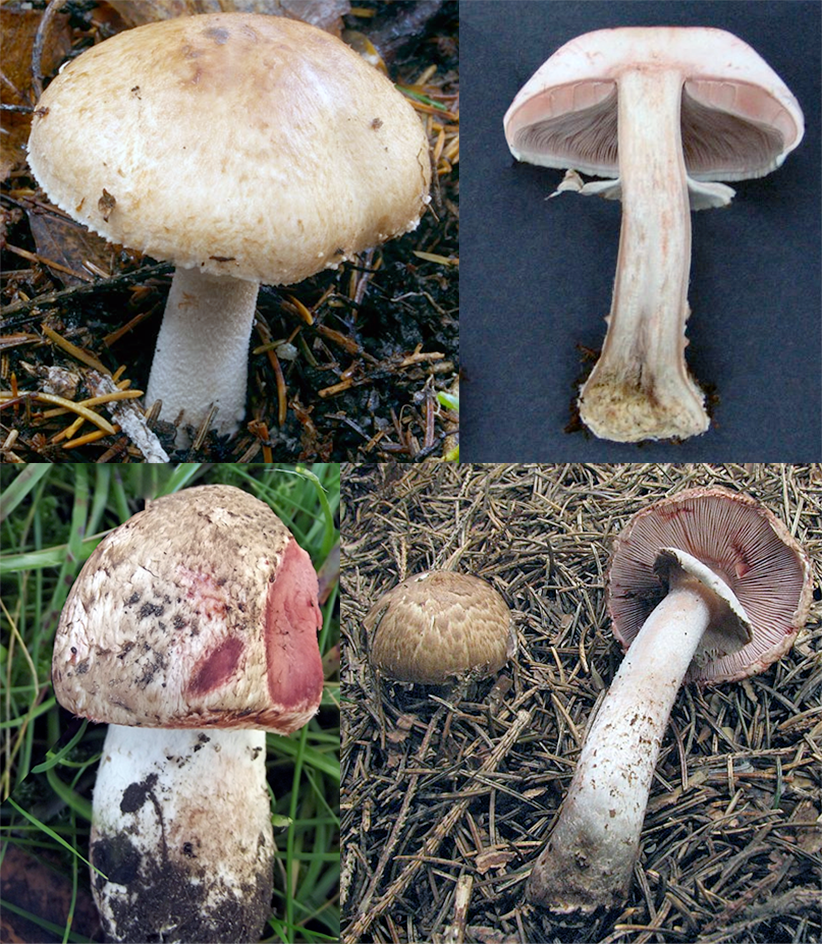
 The image, above, shows a range of pictures of Blushing Wood
Mushrooms (Agaricus sylvaticus), shown in various views,
including a mature specimen, young specimen cut to show the
blushing flesh, specimen sliced in half, a very young cap and a
mature specimen on its side..
| Common Name: Blushing Wood Mushroom |
| Scientific Name: Agaricus sylvaticus |
| Other Names: Scaly Wood Mushroom, Pinewood Mushroom, Madarch Gwridog y Coed (CY) |
| Family: Agaricaceae |
| Range: Europe, North Africa and North America |
Physical Characteristics Agaricus sylvaticus is a saprophytic fungus, growing to 10cm in diameter and by 10cm in height. The species is often found in groups in coniferous forests from early summer, or September through to November
|
| Edible Parts: Caps, Stipes |
 Spore Print: Brown Spore Print: Brown
|
 Cap: Flat Cap: Flat
|
 Hymenium: N/A Hymenium: N/A
|
 Gills: Gills on hymenium Gills: Gills on hymenium
|
 Stipe: Bare Stipe: Bare
|
 Edibility Rating: 4 Edibility Rating: 4 
|
 Known Hazards: None known. However, it is recommended that it's cooked before consumption. Known Hazards: None known. However, it is recommended that it's cooked before consumption.
|
Monthly Availability:
|
Welcome to the summary page for FabulousFusionFood's Wild Food guide to Blushing Wood Mushroom along with all the Blushing Wood Mushroom containing recipes presented on this site, with 74 recipes in total.
These recipes, all contain Blushing Wood Mushroom as a major wild food ingredient.
The Blushing Wood Mushroom, Agaricus sylvaticus, (also known as Scaly Wood Mushroom, Pinewood Mushroom,) is a basidiomycete fungus (filamentous fungi composed of hyphae that reproduce sexually) and is a member of the Agaricaceae (Agaricus) family of fungi. Its species name sylvaticus is derived from a Latin root meaning 'of the woods', and it is found most commonly in coniferous woodland.
The Blushing Wood Mushroom bears a greyish-brown cap that's hemispherical when young, but later flattens out,[citation needed] growing up to 10 centimetres in diameter. It is covered with broad scales. The gills are grey when young and become much darker with age. The spores are chocolate brown. The stem is brownish, often with a hanging ring and a small bulb at the base. The flesh is white with a mild taste, turning reddish when cut.
The cap is 6-10 cm in diameter. Spherical when young becoming convex. Pale brown fibre-like lines turning into small scales over a paler background. Any bruising or damage to the cap turns almost immediately to a striking red colour. Gills are crowded and free of the stem initially off-white in colour, becoming grey to red to dark brown. The stem is 7-10cm long, 1-1.2cm in diameter. White when young turning pale tan/grey. Can have a bulbous base. This species has a large, superior, skirt with triangular scales on the underside. The flesh is white, staining very red when cut and eventually fading to brown. The spore print is brown and spores are ovoid in shape.
Maximally the cap grows to between 5 and 10cm in diameter and the stipe is usually between 3 and 7cm tall. It is widely collected and eaten and many consider it the only mushroom safe to consume. If picking in grassland and not near trees it is generally safe to pick. Typically it is confused with the Horse Mushroom, which is safe and good to eat. Care, however, should be taken not to confuse it with the poisonous Yellow Staining Mushroom Agaricus xanthodermus which grows in the same habitat but is distinguished by an unpleasant ink-like smell, its flattened top at the button stage, its white or grey gills (when young) and the cut stem that rapidly yellows. The same is true if you bruise the fungus margin with your thumb. Whilst not fatal it can cause severer gastric upset and diarrhoea in some for several days. The Yellow-staining mushroom is occasional being much commoner in some years than others. Among the similar species mentioned above, there have been cases (in fact the most common cause of fatal fungus poisoning in France) where the deadly toxic destroying angel (Amanita bisporigera) has been consumed by individuals who mistook it for this species. However, the destroying angel has a white spore print and is typically found on mossy ground in mixed woodland, particularly near beach trees. In Britain, this species is exceedingly rare.
The smell and taste is excellent, being very mushroomy. It should be cooked before consumption. Like all Agaricus species field mushrooms lend themselves well to preserving by drying.
For other edible mushrooms, see the guide to edible mushrooms
Possible Confusion:
Agaricus haemorrhoidarius is normally considered a synonym, but has also been defined as a separate species, distinguished by its flesh which immediately turns red when cut. Agaricus phaeolepidotus is distinguished by a stem which yellows (in addition to turning pink) when cut. The cap background is browner than A. silvaticus and its smell suggests iodine or ink. Tricholoma vaccinum looks similar from above but has no ring and develops reddish-brown gills.
[2]. Huxley, A. The New RHS Dictionary of Gardening. 1999
[3]. Tanaka, T. Tanaka's Cyclopaedia of Edible Plants of the World.
[4]. Lim T.K. Edible Medicinal And Non-Medicinal Plants, Vols 1–12.
[5]. Thomas, G. S. Perennial Garden Plants, 2004
[6]. Milner, E. Trees of Britain and Ireland, 2011
[7]. Rose, F. & O'Reilly, C. The Wild Flower Key (Revised Edition) — How to identify wild plants, trees and shrubs in Britain and Ireland, 2006
[8]. Streeter, D. & Garrard, I. The Wild Flowers of the British Isles, 1983
[9]. Clapham, A.R.; Tutin, T.G. & Moore, D.M. Flora of the British Isles, 1987
[10]. Phillips, R. Mushrooms, 2006
[11]. Jordan, P. & Wheeler, S. The Complete Book of Mushrooms: An Illustrated Encyclopedia of Edible Mushrooms, 2011
[12]. Bunker, F. Seaweeds of Britain and Ireland, Second Edition, 2017
[13]. Facciola, S. Cornucopia II — A Source Book of Edible Plants, 1998
[14]. Hartford, R. Edible and Medicinal Wild Plants of Britain and Ireland: A Foraging and Photographic Identification Guide
(Note that the above book links are Amazon Affiliate links)
These recipes, all contain Blushing Wood Mushroom as a major wild food ingredient.
The Blushing Wood Mushroom, Agaricus sylvaticus, (also known as Scaly Wood Mushroom, Pinewood Mushroom,) is a basidiomycete fungus (filamentous fungi composed of hyphae that reproduce sexually) and is a member of the Agaricaceae (Agaricus) family of fungi. Its species name sylvaticus is derived from a Latin root meaning 'of the woods', and it is found most commonly in coniferous woodland.
The Blushing Wood Mushroom bears a greyish-brown cap that's hemispherical when young, but later flattens out,[citation needed] growing up to 10 centimetres in diameter. It is covered with broad scales. The gills are grey when young and become much darker with age. The spores are chocolate brown. The stem is brownish, often with a hanging ring and a small bulb at the base. The flesh is white with a mild taste, turning reddish when cut.
The cap is 6-10 cm in diameter. Spherical when young becoming convex. Pale brown fibre-like lines turning into small scales over a paler background. Any bruising or damage to the cap turns almost immediately to a striking red colour. Gills are crowded and free of the stem initially off-white in colour, becoming grey to red to dark brown. The stem is 7-10cm long, 1-1.2cm in diameter. White when young turning pale tan/grey. Can have a bulbous base. This species has a large, superior, skirt with triangular scales on the underside. The flesh is white, staining very red when cut and eventually fading to brown. The spore print is brown and spores are ovoid in shape.
Maximally the cap grows to between 5 and 10cm in diameter and the stipe is usually between 3 and 7cm tall. It is widely collected and eaten and many consider it the only mushroom safe to consume. If picking in grassland and not near trees it is generally safe to pick. Typically it is confused with the Horse Mushroom, which is safe and good to eat. Care, however, should be taken not to confuse it with the poisonous Yellow Staining Mushroom Agaricus xanthodermus which grows in the same habitat but is distinguished by an unpleasant ink-like smell, its flattened top at the button stage, its white or grey gills (when young) and the cut stem that rapidly yellows. The same is true if you bruise the fungus margin with your thumb. Whilst not fatal it can cause severer gastric upset and diarrhoea in some for several days. The Yellow-staining mushroom is occasional being much commoner in some years than others. Among the similar species mentioned above, there have been cases (in fact the most common cause of fatal fungus poisoning in France) where the deadly toxic destroying angel (Amanita bisporigera) has been consumed by individuals who mistook it for this species. However, the destroying angel has a white spore print and is typically found on mossy ground in mixed woodland, particularly near beach trees. In Britain, this species is exceedingly rare.
The smell and taste is excellent, being very mushroomy. It should be cooked before consumption. Like all Agaricus species field mushrooms lend themselves well to preserving by drying.
For other edible mushrooms, see the guide to edible mushrooms
Possible Confusion:
Agaricus haemorrhoidarius is normally considered a synonym, but has also been defined as a separate species, distinguished by its flesh which immediately turns red when cut. Agaricus phaeolepidotus is distinguished by a stem which yellows (in addition to turning pink) when cut. The cap background is browner than A. silvaticus and its smell suggests iodine or ink. Tricholoma vaccinum looks similar from above but has no ring and develops reddish-brown gills.
References:
[1]. David Evans Notes from field observations, tastings and cookery experiments.[2]. Huxley, A. The New RHS Dictionary of Gardening. 1999
[3]. Tanaka, T. Tanaka's Cyclopaedia of Edible Plants of the World.
[4]. Lim T.K. Edible Medicinal And Non-Medicinal Plants, Vols 1–12.
[5]. Thomas, G. S. Perennial Garden Plants, 2004
[6]. Milner, E. Trees of Britain and Ireland, 2011
[7]. Rose, F. & O'Reilly, C. The Wild Flower Key (Revised Edition) — How to identify wild plants, trees and shrubs in Britain and Ireland, 2006
[8]. Streeter, D. & Garrard, I. The Wild Flowers of the British Isles, 1983
[9]. Clapham, A.R.; Tutin, T.G. & Moore, D.M. Flora of the British Isles, 1987
[10]. Phillips, R. Mushrooms, 2006
[11]. Jordan, P. & Wheeler, S. The Complete Book of Mushrooms: An Illustrated Encyclopedia of Edible Mushrooms, 2011
[12]. Bunker, F. Seaweeds of Britain and Ireland, Second Edition, 2017
[13]. Facciola, S. Cornucopia II — A Source Book of Edible Plants, 1998
[14]. Hartford, R. Edible and Medicinal Wild Plants of Britain and Ireland: A Foraging and Photographic Identification Guide
(Note that the above book links are Amazon Affiliate links)
The alphabetical list of all Blushing Wood Mushroom recipes on this site follows, (limited to 100 recipes per page). There are 74 recipes in total:
Page 1 of 1
Page 1 of 1