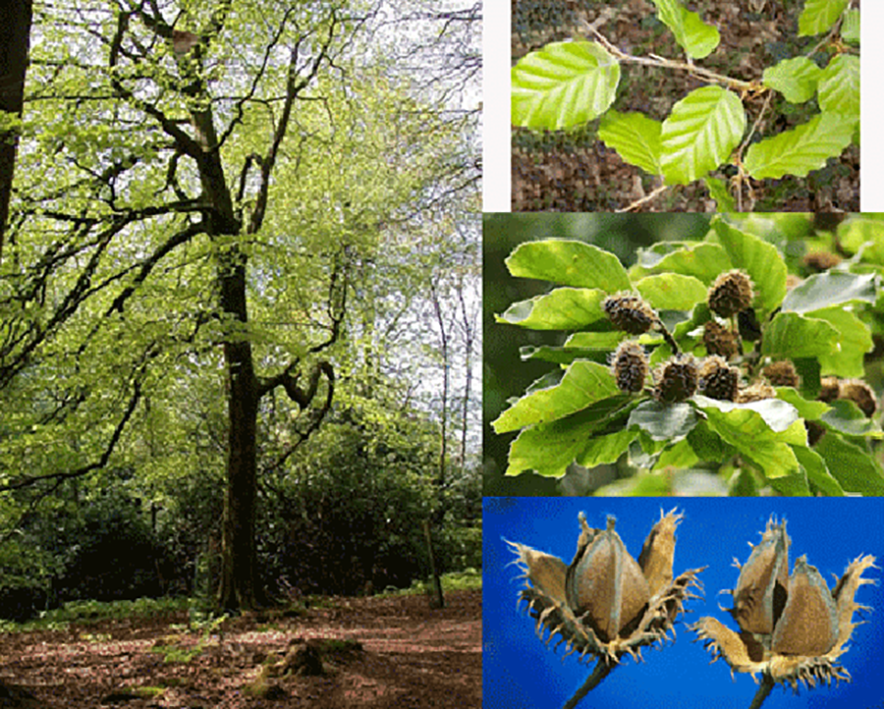
 The image, above, shows the full beech tree (Fagus
sylvatica), left, with the young edible leaves, top right.
Leaves and fruit clusters are shown right, middle, and the open
fruit, revealing the beech masts within are shown bottom, right..
| Common Name: Beech |
| Other Names: European beech, Common Beech |
| Scientific Name: Rumex alpinus |
| Family: Fagaceae |
| Range: Europe, including Britain, from Norway south and east to Spain, Greece, W. Russia and the Crimea. |
Physical Characteristics Fagus sylvatica is a hardy deciduous tree, growing to 30m (100 ft) by 15m (50 ft) in size. It is hardy to zone 5 and is not frost tender. The tree flowers from April to May and seeds ripen from September to October. The flowers are monoecious (either male or female) and both sexes can be found on the same plant. The tree is wind pollinated and the tree is a notable wildlife attractant.
|
| Edible Parts: Young Leaves, Seeds, Male Flowers (Catkins) |
 Edibility Rating: 4 Edibility Rating: 4 
|
 Known Hazards: Though, in general the leaves and masts are safe to eat, there are some reports that when consumed in large quantities, the seeds may be toxic. Known Hazards: Though, in general the leaves and masts are safe to eat, there are some reports that when consumed in large quantities, the seeds may be toxic.
|
Monthly Availability: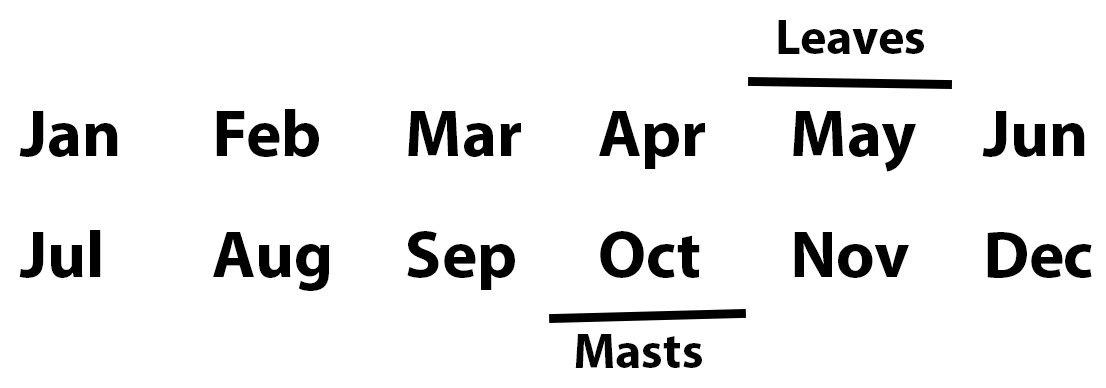
|
Welcome to the summary page for FabulousFusionFood's Wild Food guide to Beech along with all the Beech containing recipes presented on this site, with 14 recipes in total.
These recipes, all contain Beech as a major wild food ingredient.
The beech Fagus sylvatica is one of the forest's most beautiful trees, with leaves that range in colour from lime green in spring to dark green in summer. In autumn the leaves dry-up on the tree and turn a beautiful coppery colour. Indeed, with its coppery garb it is far easier to spot a beech tree late autumn than any other season. It is during this time also that the beech's fruit become ripe. Beech fruit is called a mast (these are shown in the image above, right centre). When mature the masts open to reveal three beech nuts (above right, bottom) that eventually fall to the ground. The nuts themselves are covered in a thin husk which is easy to peel with your fingernail. Inside you will find the white flesh of the nut which is sweet and delicious to eat. Indeed, the beech nut is one of the tastiest of the nuts available to the forager, but they are small and fiddly to handle, so you will need patience to collect any reasonable quantity. However, whole beech masts can also be processed into an oil that can be used for cooking or as a dressing with 500g of masts yielding as much as 80ml of oil.
The male flowers or catkins are also edible (just) they contain about 20% protein, mostly from the pollen and pollen cells but need to be treated with an osmotic agent (sugar!) to break down the cell walls and make them more digestible. They can be used in the preparation of both sweet savoury dishes and, even better they're out and mature from later February through early March when not many other edibles are available.
It should be noted that the very young leaves of the beech tree (above right, top) are also edible and make a delicious addition to any salad. Why not try them in the Hedgerow Salad recipe given below:
[2]. Huxley, A. The New RHS Dictionary of Gardening. 1999
[3]. Tanaka, T. Tanaka's Cyclopaedia of Edible Plants of the World.
[4]. Lim T.K. Edible Medicinal And Non-Medicinal Plants, Vols 1–12.
[5]. Thomas, G. S. Perennial Garden Plants, 2004
[6]. Milner, E. Trees of Britain and Ireland, 2011
[7]. Rose, F. & O'Reilly, C. The Wild Flower Key (Revised Edition) — How to identify wild plants, trees and shrubs in Britain and Ireland, 2006
[8]. Streeter, D. & Garrard, I. The Wild Flowers of the British Isles, 1983
[9]. Clapham, A.R.; Tutin, T.G. & Moore, D.M. Flora of the British Isles, 1987
[10]. Phillips, R. Mushrooms, 2006
[11]. Jordan, P. & Wheeler, S. The Complete Book of Mushrooms: An Illustrated Encyclopedia of Edible Mushrooms, 2011
[12]. Bunker, F. Seaweeds of Britain and Ireland, Second Edition, 2017
[13]. Facciola, S. Cornucopia II — A Source Book of Edible Plants, 1998
[14]. Hartford, R. Edible and Medicinal Wild Plants of Britain and Ireland: A Foraging and Photographic Identification Guide
(Note that the above book links are Amazon Affiliate links)
These recipes, all contain Beech as a major wild food ingredient.
The beech Fagus sylvatica is one of the forest's most beautiful trees, with leaves that range in colour from lime green in spring to dark green in summer. In autumn the leaves dry-up on the tree and turn a beautiful coppery colour. Indeed, with its coppery garb it is far easier to spot a beech tree late autumn than any other season. It is during this time also that the beech's fruit become ripe. Beech fruit is called a mast (these are shown in the image above, right centre). When mature the masts open to reveal three beech nuts (above right, bottom) that eventually fall to the ground. The nuts themselves are covered in a thin husk which is easy to peel with your fingernail. Inside you will find the white flesh of the nut which is sweet and delicious to eat. Indeed, the beech nut is one of the tastiest of the nuts available to the forager, but they are small and fiddly to handle, so you will need patience to collect any reasonable quantity. However, whole beech masts can also be processed into an oil that can be used for cooking or as a dressing with 500g of masts yielding as much as 80ml of oil.
The male flowers or catkins are also edible (just) they contain about 20% protein, mostly from the pollen and pollen cells but need to be treated with an osmotic agent (sugar!) to break down the cell walls and make them more digestible. They can be used in the preparation of both sweet savoury dishes and, even better they're out and mature from later February through early March when not many other edibles are available.
It should be noted that the very young leaves of the beech tree (above right, top) are also edible and make a delicious addition to any salad. Why not try them in the Hedgerow Salad recipe given below:
References:
[1]. David Evans Notes from field observations, tastings and cookery experiments.[2]. Huxley, A. The New RHS Dictionary of Gardening. 1999
[3]. Tanaka, T. Tanaka's Cyclopaedia of Edible Plants of the World.
[4]. Lim T.K. Edible Medicinal And Non-Medicinal Plants, Vols 1–12.
[5]. Thomas, G. S. Perennial Garden Plants, 2004
[6]. Milner, E. Trees of Britain and Ireland, 2011
[7]. Rose, F. & O'Reilly, C. The Wild Flower Key (Revised Edition) — How to identify wild plants, trees and shrubs in Britain and Ireland, 2006
[8]. Streeter, D. & Garrard, I. The Wild Flowers of the British Isles, 1983
[9]. Clapham, A.R.; Tutin, T.G. & Moore, D.M. Flora of the British Isles, 1987
[10]. Phillips, R. Mushrooms, 2006
[11]. Jordan, P. & Wheeler, S. The Complete Book of Mushrooms: An Illustrated Encyclopedia of Edible Mushrooms, 2011
[12]. Bunker, F. Seaweeds of Britain and Ireland, Second Edition, 2017
[13]. Facciola, S. Cornucopia II — A Source Book of Edible Plants, 1998
[14]. Hartford, R. Edible and Medicinal Wild Plants of Britain and Ireland: A Foraging and Photographic Identification Guide
(Note that the above book links are Amazon Affiliate links)
The alphabetical list of all Beech recipes on this site follows, (limited to 100 recipes per page). There are 14 recipes in total:
Page 1 of 1
| Beech Mast Oil Origin: Britain | Catkin Crumb Coating Origin: Britain | Honey and Catkin Grain Biscuits Origin: Britain |
| Beech Nut Muffins Origin: Britain | Catkin Crumb Pancakes Origin: Britain | Spring Flower Salad with Dandelion Greens Origin: Britain |
| Beech-nut Flour Origin: Britain | Catkin Crumb Suya Chicken Wings Origin: African Fusion | Springtime Fritters Origin: Ancient |
| Candied Catkins, Catkin Flour and Catkin Syrup Origin: Britain | Catkin Spicy Avocado Bites Origin: Britain | Tarragon and Beech Mast Vinaigrette Origin: Britain |
| Catkin Crumb Biscuits Origin: Britain | Chickweed Salad Origin: Britain |
Page 1 of 1