FabulousFusionFood's Lamb-based Recipes 3rd Page
 Mature lamb and a selection of lamb cuts.
Welcome to FabulousFusionFood's Lamb-based Recipes Page — The recipes presented here are all based on cow meat. Lamb represents a young sheep (Ovis aries) which is less than one year old.
Hogget is term for a sheep of either sex having no more than two permanent incisors in wear, or its meat. In the UK, it means animals that are 11 to 24 months old. Still common in farming usage and among speciality butchers, it is now a rare term in British, Australian and New Zealand supermarkets, where meat of all sheep less than two years old tends to be called 'lamb'.
Other types of lamb are as follows:
Suckling lamb or milk-fed lamb — meat from an unweaned lamb, typically 4–6 weeks old and weighing 5.5–8 kg. This is typically generally unavailable in the UK but can be sourced from speciality butchers and farm shops.
Young lamb — a milk-fed lamb between six and eight weeks old
Spring lamb — a lamb, usually three to five months old, born in late winter or early spring and sold usually before 1 July (in the northern hemisphere).
Yearling lamb — a young sheep between 12 and 24 months old
Salt marsh lamb (also known as 'saltmarsh lamb' or by its French name, agneau de pré-salé) is the meat of sheep which graze on salt marsh in coastal estuaries that are washed by the tides and support a range of salt-tolerant grasses and herbs, such as samphire, sparta grass, sorrel and sea lavender.
The meat of a lamb is taken from the animal between one month and one year old, with a carcass weight of between 5.5 and 30 kg (12 and 66 lb). This meat generally is more tender than that from older sheep and appears more often on tables in some Western countries.
Sheep are most likely descended from the wild mouflon of Europe and Asia, with Iran being a geographic envelope of the domestication centre. One of the earliest animals to be domesticated for agricultural purposes, sheep are raised for fleeces, meat (lamb, hogget or mutton), and milk. A sheep's wool is the most widely used animal fibre, and is usually harvested by shearing. In Commonwealth countries, ovine meat is called lamb when from younger animals and mutton when from older ones; in the United States, meat from both older and younger animals is usually called lamb. Sheep continue to be important for wool and meat today, and are also occasionally raised for pelts, as dairy animals, or as model organisms for science.
Sheep meat and milk were one of the earliest staple proteins consumed by human civilization after the transition from hunting and gathering to agriculture. Sheep meat prepared for food is known as either mutton or lamb, and approximately 540 million sheep are slaughtered each year for meat worldwide. "Mutton" is derived from the Old French moton, which was the word for sheep used by the Anglo-Norman rulers of much of the British Isles in the Middle Ages. This became the name for sheep meat in English, while the Old English word sceap was kept for the live animal. Throughout modern history, "mutton" has been limited to the meat of mature sheep usually at least two years of age; "lamb" is used for that of immature sheep less than a year.
Cuts of Lamb (UK, Canada, and other Commonwealth countries):
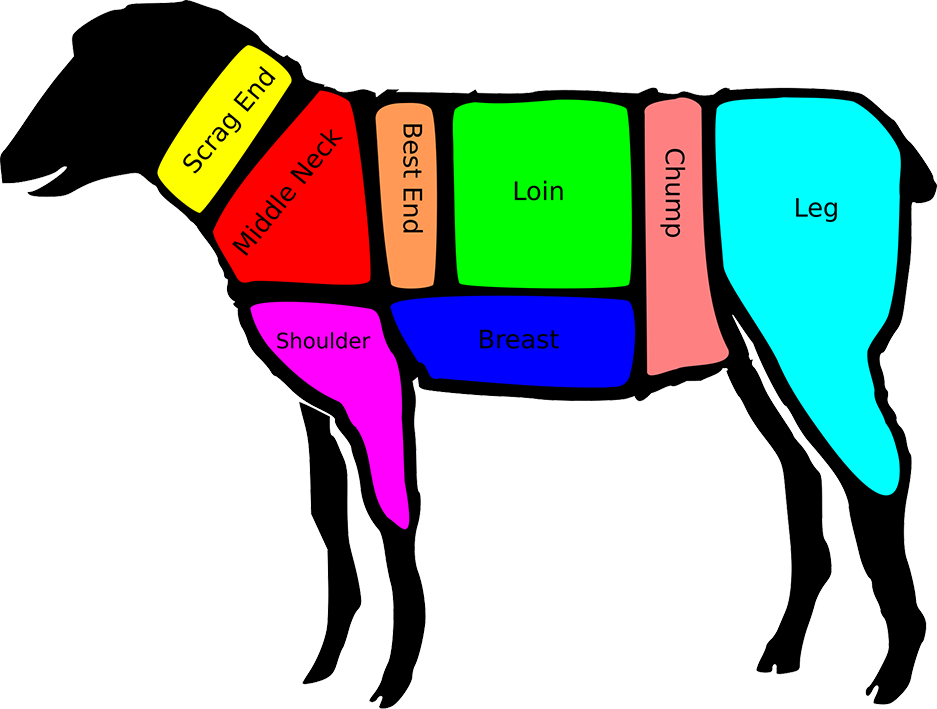 Cuts of Lamb:
Scrag end (of neck) — stewing
Middle neck — braising, stewing
Best End (of neck) — roasting, stewing, braising
Loin (including chops, racks and saddle) — roasting, frying, braising
Chump (and chump chops) — frying
Barnsley chop, a large double loin chop — frying
Leg (gigot in Scotland) including leg steaks — roasting, frying
Shank — braising
Shoulder — roasting Breast — braising
Offal — typically tongue, liver, heart, stomach, sweetbreads, testicles, intestines and kidneys
The alphabetical list of all the lamb-based recipes on this site follows, (limited to 100 recipes per page). There are 621 recipes in total:
Page 3 of 7
| Haggis Origin: Scotland | Kafta with Argan Oil (Syrian Meatballs with Argan Oil) Origin: Syria | Kiwi Lamb Curry Origin: New Zealand |
| Haggis Balls with Mustard-whisky Sauce Origin: Scotland | Kaldi (Algerian Crescent Pastries) Origin: Algeria | Kjötsúpa II (Lamb Soup) Origin: Iceland |
| Hairst Bree (Harvest Broth) Origin: Scotland | Kale mamoe saka (Lamb Flaps Curry) Origin: Samoa | Kjötsúpa (Icelandic Lamb Stew) Origin: Iceland |
| Hara Mircha (Bell Pepper Curry) Origin: India | Kalia (Meat and Potato Curry) Origin: Bangladesh | Kleftiko (Lamb in the Oven) Origin: Cyprus |
| Harees Origin: UAE | Kansiyé Origin: Guinea | Kleftiko (Roast Leg of Lamb) Origin: Cyprus |
| Harees Origin: Oman | Kazakh Shashlik Origin: Kazakhstan | Kofta Nakhod (Meatballs with Chickpeas) Origin: Afghanistan |
| Harees Origin: Bahrain | Kazakiye Riz (Kazkah Rice) Origin: Kazakhstan | Kofta Nakhod (Meatballs with Chickpeas) Origin: Tajikistan |
| Harira Bidaouia Origin: Morocco | Kebabpizza (Kebab Pizza) Origin: Sweden | Kokoretsi Origin: Greece |
| Harira Mauritanienne (Mauritanian Harira) Origin: Mauritania | Kebbe bi Saynyeh (Baked Kebbe) Origin: Lebanon | Koozy II (Leg of Lamb) Origin: Iraq |
| Harissa Lamb Noodles Origin: Fusion | Kebbe Blaban (Kebbe in Yoghurt Sauce) Origin: Lebanon | Korean-flavoured Lamb Shanks with Swede and Potato Mash Origin: Fusion |
| Hashwe Stuffing Origin: Arabia | Keema Curry Origin: Pakistan | Kuşburnu çorbası (Rosehip and Meatball Soup) Origin: Turkey |
| Highveld Lamb Curry Origin: South Africa | Keema Mattar Origin: India | Kuru Fasulye Origin: Turkey |
| Hlalem (Pasta with Beans) Origin: Tunisia | Keema Naan Origin: India | Kuzu Çorbası (Lamb Soup) Origin: Turkey |
| Home-made Gyros Origin: Greece | Keftedes (Greek Meatballs) Origin: Greece | Kuzu Pirzola (Turkish-style Lamb Chops) Origin: Turkey |
| Hægeldaðir lambalæri (Slow-cooked Lamb Shanks) Origin: Iceland | Keftedhes Arnisious Skharas (Lamb Patties, Cypriot Style) Origin: Cyprus | Kyrgyz Shashlik Origin: Kyrgyzstan |
| In ficato oenogarum (Livers of Animals Fattened on Figs, Another Way) Origin: Roman | Keleya Zaara (Tunisian Lamb with Saffron) Origin: Tunisia | L'Ham Lahlou (Sweet Lamb for Ramadan) Origin: Algeria |
| In ficato oenogarum (Wine Sauce for the Livers of Animals Fattened on Figs) Origin: Roman | Kereviz Geragoor (Celery Stew) Origin: Armenia | Laal Maas (Spicy Red Lamb Shank Curry) Origin: India |
| Indian Koftas Origin: Fusion | Kerrieboontjies (South African Curried Beans) Origin: South Africa | Laal Maas (Rajasthani Lamb Curry) Origin: India |
| Indian Takeaway Style Seekh Kebabs Origin: Britain | Keşkek (Slow-cooked Lamb and Farro Stew) Origin: Turkey | Lahm bi Agine Mankoushe (Lebanese Lamb Pizza) Origin: Lebanon |
| Iraqi Dolma Origin: Iraq | Khabourga (Stuffed Lamb Flank) Origin: Armenia | Lahm Lhalou (Lamb Stew with Prunes) Origin: Algeria |
| Iraqi Kababs Origin: Iraq | Khanum Budu (Egg-coated Meat Patty) Origin: Armenia | Lahma Mu'assaga (Savoury Minced Lamb) Origin: Egypt |
| Irish Lamb and Potato Curry Origin: Ireland | Khela Kalia (West Bengali Lamb Curry) Origin: India | Lahmacun (Turkish Cypriot-style Pizza) Origin: Northern Cyprus |
| Irish Lamb Stew Origin: Ireland | Khinkali Origin: Georgia | Lahmajoun Origin: Armenia |
| Irish Lamb Stew Origin: Ireland | Khoresht Rivas (Persian Lamb and Rhubarb Stew) Origin: Iran | Lale Mamoe (Samoan Lamb Curry) Origin: Samoa |
| Irish Stew Origin: Ireland | Khoresht-e Gheymeh (Persian Lamb Stew with Dried Limes and Split Peas) Origin: Iran | Lamb & Water Mint Meatballs Origin: Britain |
| Irish Stock Origin: Ireland | Khoresht-e Zereshk (Barberry, Lamb and Nut Stew) Origin: Iran | Lamb and Apricot Cape Malay Curry Origin: South Africa |
| Isi Ewu (Spiced Goat Head) Origin: Nigeria | Khoreshte Kalal (Lamb Stew with Barberry Sauce) Origin: Iran | Lamb and Cabbage Rolls Origin: Britain |
| Isicia Omentata (Roman Burgers) Origin: Roman | Khormya (Spiced Lamb with Yoghurt) Origin: Kazakhstan | Lamb Bhuna Origin: Britain |
| Jahnija (Bosnian Lamb and Vegetable Stew) Origin: Bosnia | Khuzi (Emirati Lamb with Rice) Origin: UAE | Lamb Bhuna Origin: India |
| Japrak (Mutton-stuffed Vine Leaves) Origin: Bosnia | Kibbeh Origin: Lebanon | Lamb Biryani Origin: Britain |
| Jerk Kebabs Origin: Jamaica | Kibbeh Origin: Syria | Lamb Biryani Origin: India |
| Jerk Lamb Chops Origin: Cayman Islands | Kidney and Beef Soup Origin: Britain | Lamb Burgers with Mint and Pine Nuts Origin: Cyprus |
| Jollof Rice with Lamb Origin: Mali | Kifta Lil Atfaal (Cinnamon Meatballs) Origin: Libya | |
| Kadhai Gosht Origin: Pakistan | Kishmish Vashli Tolma Origin: Armenia |
Page 3 of 7