FabulousFusionFood's Lamb-based Recipes 6th Page
 Mature lamb and a selection of lamb cuts.
Welcome to FabulousFusionFood's Lamb-based Recipes Page — The recipes presented here are all based on cow meat. Lamb represents a young sheep (Ovis aries) which is less than one year old.
Hogget is term for a sheep of either sex having no more than two permanent incisors in wear, or its meat. In the UK, it means animals that are 11 to 24 months old. Still common in farming usage and among speciality butchers, it is now a rare term in British, Australian and New Zealand supermarkets, where meat of all sheep less than two years old tends to be called 'lamb'.
Other types of lamb are as follows:
Suckling lamb or milk-fed lamb — meat from an unweaned lamb, typically 4–6 weeks old and weighing 5.5–8 kg. This is typically generally unavailable in the UK but can be sourced from speciality butchers and farm shops.
Young lamb — a milk-fed lamb between six and eight weeks old
Spring lamb — a lamb, usually three to five months old, born in late winter or early spring and sold usually before 1 July (in the northern hemisphere).
Yearling lamb — a young sheep between 12 and 24 months old
Salt marsh lamb (also known as 'saltmarsh lamb' or by its French name, agneau de pré-salé) is the meat of sheep which graze on salt marsh in coastal estuaries that are washed by the tides and support a range of salt-tolerant grasses and herbs, such as samphire, sparta grass, sorrel and sea lavender.
The meat of a lamb is taken from the animal between one month and one year old, with a carcass weight of between 5.5 and 30 kg (12 and 66 lb). This meat generally is more tender than that from older sheep and appears more often on tables in some Western countries.
Sheep are most likely descended from the wild mouflon of Europe and Asia, with Iran being a geographic envelope of the domestication centre. One of the earliest animals to be domesticated for agricultural purposes, sheep are raised for fleeces, meat (lamb, hogget or mutton), and milk. A sheep's wool is the most widely used animal fibre, and is usually harvested by shearing. In Commonwealth countries, ovine meat is called lamb when from younger animals and mutton when from older ones; in the United States, meat from both older and younger animals is usually called lamb. Sheep continue to be important for wool and meat today, and are also occasionally raised for pelts, as dairy animals, or as model organisms for science.
Sheep meat and milk were one of the earliest staple proteins consumed by human civilization after the transition from hunting and gathering to agriculture. Sheep meat prepared for food is known as either mutton or lamb, and approximately 540 million sheep are slaughtered each year for meat worldwide. "Mutton" is derived from the Old French moton, which was the word for sheep used by the Anglo-Norman rulers of much of the British Isles in the Middle Ages. This became the name for sheep meat in English, while the Old English word sceap was kept for the live animal. Throughout modern history, "mutton" has been limited to the meat of mature sheep usually at least two years of age; "lamb" is used for that of immature sheep less than a year.
Cuts of Lamb (UK, Canada, and other Commonwealth countries):
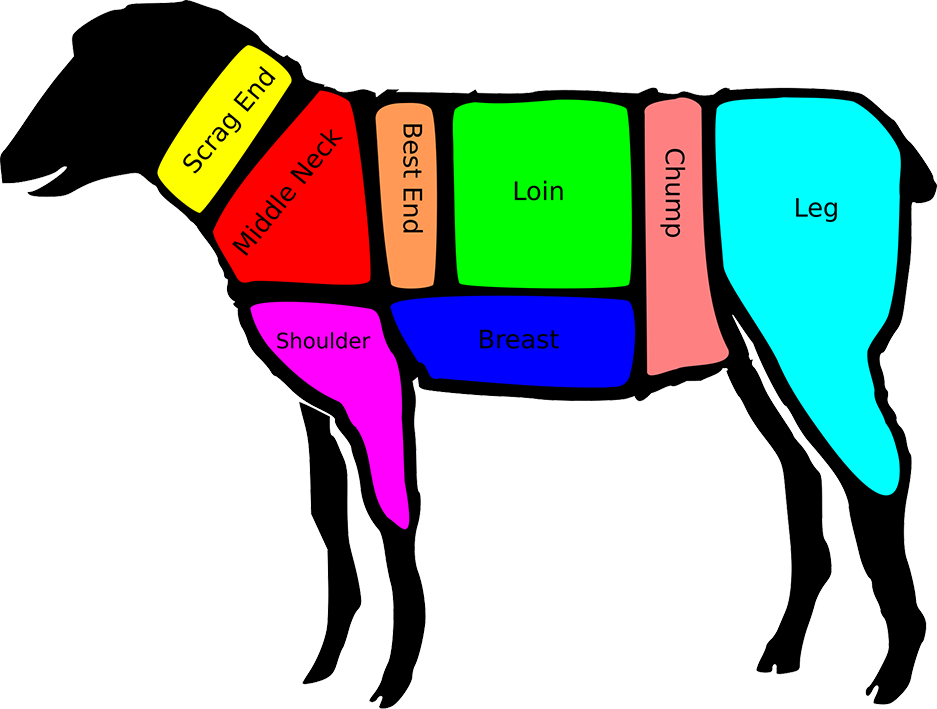 Cuts of Lamb:
Scrag end (of neck) — stewing
Middle neck — braising, stewing
Best End (of neck) — roasting, stewing, braising
Loin (including chops, racks and saddle) — roasting, frying, braising
Chump (and chump chops) — frying
Barnsley chop, a large double loin chop — frying
Leg (gigot in Scotland) including leg steaks — roasting, frying
Shank — braising
Shoulder — roasting Breast — braising
Offal — typically tongue, liver, heart, stomach, sweetbreads, testicles, intestines and kidneys
The alphabetical list of all the lamb-based recipes on this site follows, (limited to 100 recipes per page). There are 621 recipes in total:
Page 6 of 7
| Scotch Broth with Pepper Dulse Origin: Scotland | Somali-style Liver Origin: Somalia | Tagine bal Ghalmi wa Aflour (Lamb Tagine with Broad Beans) Origin: Morocco |
| Setsamandi (Lamb, Rice and Herb Gruel) Origin: Georgia | Sorrel Sarma Origin: North Macedonia | Tagine bal Ghalmi wa Gharraa wa Na'Na' (Lamb Tagine with Courgette and Mint) Origin: Morocco |
| Shaiyah (Pan-fried Meat) Origin: South Sudan | Soupe aux pois et la viande (Pea Soup and Meat) Origin: Guinea-Bissau | Tagine bel Ghamli wal Barkouk wa Geijlane (Lamb Tagine with Prunes and Sesame Seeds) Origin: Morocco |
| Shakshouka 2 (Chilli, Egg and Tomato Breakfast) Origin: Yemen | Soupe d'Illane (Ilan Soup) Origin: Morocco | Tagine Lahm bil Beleh (Lamb Tagine with Dates) Origin: Morocco |
| Shami Kebab Origin: India | Souppa Patchia (Lamb's Head Soup) Origin: Cyprus | Tagine of Lamb with Pumpkin Origin: North Africa |
| Sharba Ramadan (Ramadan Soup) Origin: Libya | South African Cape Malay Curry Origin: South Africa | Tandoori Lamb Chops Origin: Britain |
| Sharbat Libya (Libyan Soup) Origin: Libya | South African Curried Leg of Lamb Origin: India | Tanzanian Meat Stew Origin: Tanzania |
| Shashlyk Origin: Azerbaijan | South African Lamb Curry Origin: South Africa | Tarten Oen a Bricyll gyda Crwst Persli (Lamb and Apricot Pie with Parsley Crust) Origin: Welsh |
| Shawarma-style pulled lamb with tahini-yogurt dressing Origin: Fusion | South African Lamb Pilaff Origin: South Africa | Tarten Sibolau a Bacwn (Shepherd's Pie with Cheese-crusted Leek Topping) Origin: Welsh |
| Sheftalia (Grilled Spiced Meat Rolls) Origin: Cyprus | Souvlaki Origin: Greece | Tas-Kebab (Lamb Cooked in Wine) Origin: Bulgaria |
| Sheikh Kebab Origin: India | Spiced Sesame Lamb Patties Origin: Fusion | Tasqebap (Fried Lamb with Tomatoes) Origin: Albania |
| Shepherd's Pie Origin: Britain | Spicy Lamb Burgers Origin: Britain | Tass Kebab (Fried Lamb in Tomato Sauce) Origin: Armenia |
| Shifa (Lebanese Lamb and Pine Nut Pizza) Origin: Lebanon | Spicy Lamb Kebabs Origin: Britain | Tatws â Chig yn y Popty (Meat and Potatoes in the Oven) Origin: Welsh |
| Shisa Nyama Origin: South Africa | St Helena Curry and Rice Origin: St Helena | Tatws a Chig Mewn Popty Araf (Potatoes and Meat in the Slow Cooker) Origin: Welsh |
| Shisa Nyama Origin: eSwatini | St Lucian Pepper Pot Origin: Saint Lucia | Tavë Kosi (Baked Lamb and Yoghurt) Origin: Albania |
| Shish Kebabs Origin: Britain | Steak and Kidney Kebabs Origin: Britain | Tavë Kosi (Baked Lamb and Yoghurt) Origin: Kosovo |
| Shorba Origin: Sudan-a | Stecen Cig Oen Gyda Rhosmari a Cwrens Cochion (Lamb Steak with Rosemary and Red Currants) Origin: Welsh | Tave Elbanasi (Boiled Lamb with Yoghurt) Origin: Albania |
| Shurpa Origin: Uzbekistan | Sticky Lamb Ribs Origin: Britain | Tave Kosi 2 (Baked Lamb with Yoghurt) Origin: Albania |
| Shuwa (Slow-cooked Spicy Lamb) Origin: Oman | Stir-fried Lamb with Spring Onions Origin: China | Teisen Nionod â Chig Oen (Welsh Onion Cake with Lamb) Origin: Welsh |
| Shuwa II Origin: Oman | Stir-fried Lamb with Three-Cornered Leeks Origin: China | Tepsi kebabı (Turkish Tray Kebab) Origin: Turkey |
| Sieftalia (Caul-wrapped Lamb Sausages) Origin: Cyprus | Stiw Cig Oen Cymreig (Welsh Lamb Stew) Origin: Welsh | Terîn Cig Oen (Welsh Lamb Terrine) Origin: Welsh |
| Sindhi-style Pilau Origin: Pakistan | Stovies Origin: Scotland | Thyme-scented Lamb with Almond Skordalia Origin: Australia |
| Şiş Kebab Origin: Northern Cyprus | Suaasat Origin: Greenland | Tishreeb Hummus (Chickpea Casserole) Origin: Iraq |
| Sis Kebap (Turkish Shish Kebab) Origin: Turkey | Suani Tadjine (Kitchen Garden Tagine) Origin: Algeria | To Dress a Hen, Mutton or Lamb the Indian Way Origin: England |
| Skoudehkaris (Djibouti Rice) Origin: Djibouti | Sugar Bean Curry Origin: South Africa | To Fricasey White Meat Origin: Britain |
| Slow Cooker Lamb Rogan Josh Origin: Britain | Summer Lamb Casserole Origin: Britain | Toad-in-the-Hole Origin: Britain |
| Slow-cooked Lamb Curry Origin: Britain | Super-speedy Microwave Lamb Curry Origin: Britain | Tolma (Cabbage Stuffed with Lamb) Origin: Georgia |
| Slow-cooked Lamb Madras Origin: Britain | Şurpa (Shurpa) Origin: Turkmenistan | Torten Oen a Thatws (Welsh Lamb and Potato Torte) Origin: Welsh |
| Slow-cooked Moorish Lamb with Buttermilk Dressing Origin: Fusion | Suya Curry Origin: Fusion | Toulouse Ragôut Origin: British |
| Slow-roast Lamb Shoulder with Honey, Herbs and Harissa Origin: Britain | Sweet Lamb Fillet Origin: Britain | Traditional Historic Bobotie Origin: South Africa |
| Slow-roasted Lamb Shanks with Tomatoes and Olives Origin: Australia | Sweetbread Croquets Origin: British | Traditional Lamb with Emerald Mint Sauce Origin: New Zealand |
| Slow-roasted Lamb with Advieh Origin: Fusion | Szureti Birkaporkolt (Mutton Porkolt) Origin: Hungary | Tsebhi Sega (Spicy Minced Meat) Origin: Eritrea |
| Soganli Yahni (Mutton Stew with Onions) Origin: Turkey | Tabah Moostafah (Tagine of Marrakech Lamb) Origin: Morocco | |
| Somali-style Liver Origin: Somaliland | Tadjine Zdef (Mutton and Cheese Tagine) Origin: Benin |
Page 6 of 7