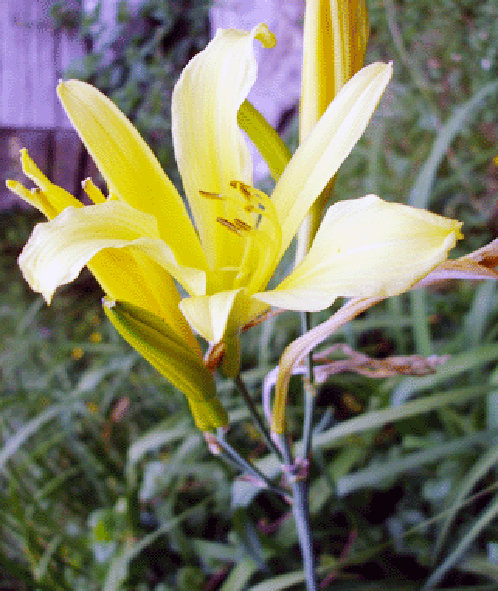
 Daylily, Hemerocallis spp flowers..
Welcome to the summary page for FabulousFusionFood's Edible Flowers guide to Daylily along with all the Daylily containing recipes presented on this site, with 7 recipes in total.
This is a continuation of an entire series of pages that will, I hope, allow my visitors to better navigate this site. As well as displaying recipes by name, country and region of origin I am now planning a whole series of pages where recipes can be located by meal type and main ingredient. This page gives a listing of all the Cornish recipes added to this site.
These recipes, all contain Daylily as a major edible flower.
The Daylily Hemerocallis spp represents a large family of species, hybrids and cultivars of the genus Hemerocallis of the Hemerocallidaceae (daylily) family of flowering perennial plants. The flowers and flower buds of some species are edible and are used in Chinese cuisine. They are sold (fresh or dried) in Asian markets as gum jum or golden needles or yellow flower vegetables (with Hemerocallis citrina being the typical species used).
Hemerocallis fulva is also of special interest to the gardener and food-lover, as it's fast-growing and the roots have edible spindle-shaped swellings. Though most daylilies are safe to eat, as a general rule of thumb, if you have not eaten daylilies before only eat a few, as they are a natural laxative. Also, the closer they are to the Chinese Hemerocallis citrina the safer they are. Orange or yellow flowers are preferable and ensure that the flowers face upwards and are unspotted. Also check the throat of the flower base — this should be yellow with a red band circling it.
The flowers of edible daylily species, particularly Hemerocallis citrina known as the Citron Daylily (黃花菜 金針菜 金针菜) is generally the most prized in Chinese cuisine and is generally considered 'premium'. Due to their short shelf life, and seasonality daylily flowers are commonly dried and sold this way for cooking in China. Dried Lily Flowers (黄花, huang hua), also known as dried lily buds or golden needles, are the unopened flowers of the day lily plant. Dried lily flowers have a brownish yellow colour (it literally means yellow flower in Chinese), with the shape and texture of a straw. They have a very strong and special woody, earthy aroma.
Daylily flowers are sold (fresh or dried) in Asian markets as gum jum or golden needles (金针 in Chinese; pinyin: jīnzhēn) or yellow flower vegetables (黃花菜 in Chinese; pinyin: huánghuācài). They are used in hot and sour soup, daylily soup (金針花湯), Buddha's delight, and moo shu pork. However, unless you know the species or cultivar take care as some species can be toxic.
This is a continuation of an entire series of pages that will, I hope, allow my visitors to better navigate this site. As well as displaying recipes by name, country and region of origin I am now planning a whole series of pages where recipes can be located by meal type and main ingredient. This page gives a listing of all the Cornish recipes added to this site.
These recipes, all contain Daylily as a major edible flower.
The Daylily Hemerocallis spp represents a large family of species, hybrids and cultivars of the genus Hemerocallis of the Hemerocallidaceae (daylily) family of flowering perennial plants. The flowers and flower buds of some species are edible and are used in Chinese cuisine. They are sold (fresh or dried) in Asian markets as gum jum or golden needles or yellow flower vegetables (with Hemerocallis citrina being the typical species used).
Hemerocallis fulva is also of special interest to the gardener and food-lover, as it's fast-growing and the roots have edible spindle-shaped swellings. Though most daylilies are safe to eat, as a general rule of thumb, if you have not eaten daylilies before only eat a few, as they are a natural laxative. Also, the closer they are to the Chinese Hemerocallis citrina the safer they are. Orange or yellow flowers are preferable and ensure that the flowers face upwards and are unspotted. Also check the throat of the flower base — this should be yellow with a red band circling it.
The flowers of edible daylily species, particularly Hemerocallis citrina known as the Citron Daylily (黃花菜 金針菜 金针菜) is generally the most prized in Chinese cuisine and is generally considered 'premium'. Due to their short shelf life, and seasonality daylily flowers are commonly dried and sold this way for cooking in China. Dried Lily Flowers (黄花, huang hua), also known as dried lily buds or golden needles, are the unopened flowers of the day lily plant. Dried lily flowers have a brownish yellow colour (it literally means yellow flower in Chinese), with the shape and texture of a straw. They have a very strong and special woody, earthy aroma.
Daylily flowers are sold (fresh or dried) in Asian markets as gum jum or golden needles (金针 in Chinese; pinyin: jīnzhēn) or yellow flower vegetables (黃花菜 in Chinese; pinyin: huánghuācài). They are used in hot and sour soup, daylily soup (金針花湯), Buddha's delight, and moo shu pork. However, unless you know the species or cultivar take care as some species can be toxic.
The alphabetical list of all recipes on this site follows, (limited to 100 recipes per page). There are 7 recipes in total:
Page 1 of 1
| Curried Daylilies Origin: Britain | Henan Hu La Tang (Hot Pepper Soup) Origin: China | Pickled Daylily Buds Origin: America |
| Daylily Flower Lo Mein Origin: American | Pasta with Daylily Flower Buds and Mushrooms Origin: American | |
| Daylily Fritters Origin: Britain |
Page 1 of 1