FabulousFusionFood's Offal-based Recipes 3rd Page
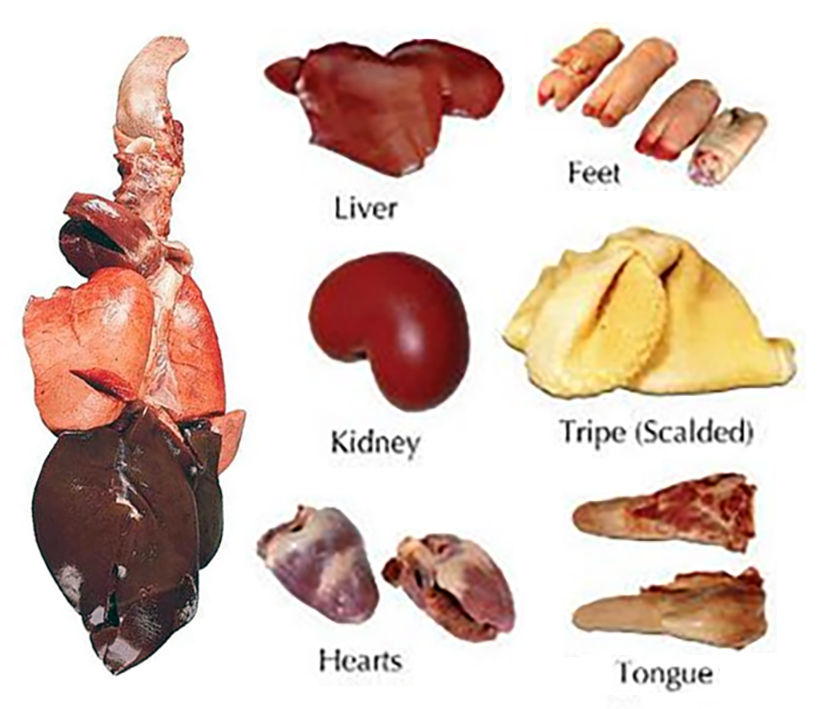 Selection of commonly-consumed offal and a whole sheep's pluck (left).
Welcome to FabulousFusionFood's Offal-based Recipes Page — The recipes presented here are all based on offal as an ingredient. Offal is often though of as the internal organs of an animal. Though cuts such as feet, skin chicken combs and animal heads (and parts thereof) are also typically included in the list of 'offal'. Essentially offal is anything apart from an animal's muscle.
Offal (sometimes know as 'speciality meats' in North America are the internal organs of animals: hearts, kidneys, liver, lungs, brains, pancreas, thymus (sweetbreads), uterus, testes, stomachs and intestines (blood, snouts, ears, tails, tongues and udders can also be added to the list) as well as other parts of the animal that might not be considered prime meat such as trotters/legs, heads and tails. Though the definition may vary by region and country (eg goat head is commonly used in Nigeria and the Caribbean, salted pig tails are a very common ingredient in the Caribbean). The other definition of 'offal' being those parts of the animal that do not contain muscle tissue (such as internal organs; though the placement of hearts become problematic as they're almost all muscle tissue).
The origin of the term in English comes from the late 14th century terms of (off) and fal (fall); literally those part of an animal that fall off the butcher's block. As a result they were often seen as poor cuts of meat, only eaten by the poor. This has resulted in offal's poor press ever since. This view of offal as being bad for you or somehow 'disgusting' has increased of late as we have moved away from the source of our meats. Certain offal also have high quantities of cholesterol (brains and liver most notably); though most people ignore the fact that some dietary cholesterol is necessary for a functioning nervous system. It's also forgotten that offal is a critical component of many delicacies (pâtés, containing liver being good examples).
In Britain many traditional dishes such as liver and onions, tripe and brawn (made from pig's head meats set in jelly) are still commonly eaten. Indeed, during Victorian times the 'pluck' of a sheep (liver, heart and lungs) were stewed and served with bread as a cheap and readily available street food. In those countries where meat is a rarity offal provides a welcome source of protein. My grandmother was very traditional when it came to offal and would often prepare it and now it's my job it prepare the offal of the turkey (giblets, heart, kidneys, neck, liver) as a dish on Christmas Eve. My wife, being West African is used to using offal as a protein source. The truth is that many kinds of offal (hearts especially) are a source of high-quality and low fat protein that we should increase in our diets. Here you will find classic recipes for offal-based or offal-containing dishes sourced from countries all across the globe.
The alphabetical list of all the offal-based recipes on this site follows, (limited to 100 recipes per page). There are 478 recipes in total:
Page 3 of 5
| Hares in Talbotes (Hares in Hare-blood Sauce) Origin: England | Kontomire Stew (Cocoyam Leaf Stew) Origin: Ghana | Masaledaar Bakre ki Kaleji Gurda Phepsa (Lamb Offal Curry) Origin: India |
| Hart rows Origin: England | Kuddelfleck (Tripe) Origin: Luxembourg | Matura and Mahu Origin: Burundi |
| Heartsease Flower Jelly Origin: Britain | Kukulhu Kurandi Riha (Maldives Chicken Gizzard Curry) Origin: Maldives | Mayiritsa (Easter Soup) Origin: Greece |
| Herodotus' Pudding Origin: Britain | Kulfi Origin: India | Me'orav Yerushalmi (Jerusalem Mixed Grill) Origin: Israel |
| Highland Game Soup Origin: Scotland | Kyinkyinga (Beef and Liver Kebabs) Origin: Ghana | Meat Steamed in Rumen Origin: Montenegro |
| Hotch Potch Origin: Scotland | Kypriaka Loucanika (Cypriot Smoked Sausages) Origin: Cyprus | Microwave Christmas Pudding Origin: Britain |
| Houska (Bohemian Easter and Christmas Cake) Origin: Czech | Laj Ntses (Fish Larb) Origin: Laos | Microwave French Country Pâté Origin: Britain |
| Howtowdie Stuffing Origin: Scotland | Lamb Tagine with Artichokes Origin: Morocco | Microwave Jam Roly-poly Pudding Origin: Britain |
| Iecinera Haedina vel Agnina (Liver of Kid Goat or Lamb) Origin: Roman | Le Me Tsolola Origin: Comoros | Milanese Ragôut Origin: British |
| Igra Stobá (Liver Stew) Origin: Bonaire | Leber Knödelsuppe (Liver Dumpling Soup) Origin: Liechtenstein | Milanese Sauce Origin: France |
| Igra Stobá (Liver Stew) Origin: Curacao | Leche Lumbard (Lombardy Cream) Origin: England | Minutal Apicianum (Ragout à la Apicius) Origin: Roman |
| In ficato oenogarum (Livers of Animals Fattened on Figs, Another Way) Origin: Roman | Lechon Kawli (Oven-roasted Pork) Origin: Philippines | Minutal ex Iecineribus et Pulmonibus Leporis (Hare's Liver and Lights Ragout) Origin: Roman |
| In ficato oenogarum (Wine Sauce for the Livers of Animals Fattened on Figs) Origin: Roman | Leek and Tripe Soup Origin: England | Mixed Grill Origin: Britain |
| In Vulva [et] Sterili ([Sauce] for Sterile Sow's Womb) Origin: Roman | Leporem farsilem (Stuffed Roast Hare with White Sauce) Origin: Roman | Mixed Grill Skewers Origin: Britain |
| Indian Dumpode Goose Origin: Anglo-Indian | Leporem Farsilem (Stuffed Hare) Origin: Roman | Miyan Wake (Beans soup) Origin: Nigeria |
| Irish Kidney Soup Origin: Ireland | Let lardes (Milk and Lard) Origin: England | Mogatla (Oxtail Casserole) Origin: Botswana |
| Iscas com Elas (Marinated Liver with Potatoes) Origin: Portugal | Liewerkniddelen (Liver Dumplings) Origin: Luxembourg | Mokoto Origin: Benin |
| Isicia de Cerebellis (Brain Dumplings) Origin: Roman | Lincolnshire Haslet Origin: England | Mollag (Manx Christmas Haggis) Origin: Manx |
| Isicia Ova et Cerebella (Egg and Brain Sausages) Origin: Roman | Liver and Heart Kofta Curry Origin: India | Montserratian Souse Origin: Montserrat |
| Israeli Halva Origin: Israel | Liver and Mushrooms with Fusilli Pasta Origin: Italy | Moroccan Shish Sesame Skewers Origin: Morocco |
| Ius Album in Assum Leporem (Hare's Blood, Liver and Lung Ragout) Origin: Roman | Liver and Onion Kebabs Origin: Britain | Moroccan-style Five-grain Pilaf Origin: African Fusion |
| Jamaican Pimento Tripe Curry Origin: Jamaica | Liver Oxyrhynchus Origin: Roman | Mortrews of Fysche (Mortar-paste of Fish) Origin: England |
| Jozi Chicken Feet Curry Origin: South Africa | Liver with St George's Mushroom Origin: Britain | Mother's Day Simnel Cupcakes Origin: Britain |
| Kangchu Tsoem (Pig's Trotter Tshoem) Origin: Bhutan | Loubia bil Luz (Green Beans with Almonds) Origin: Algeria | Mousse de Gibier (Mousse of Game) Origin: France |
| Karnache (Bulgarian Pork Sausage Rings) Origin: Bulgaria | Lumbuli assi ita fiunt (Stuffed Kidneys or Testicles) Origin: Roman | Mrs Beeton Herodotus Pudding Origin: Britain |
| Kekstorte (German Biscuit Cake) Origin: Germany | M'Chuzi wa Nyama (Zanzibar-style Beef Curry) Origin: Britain | Mû Elamūtum (Elamite Broth) Origin: Mesopotamia |
| Kerrie Sult (Curried Brawn) Origin: South Africa | Magatla (Oxtail Casserole) Origin: Botswana | Mutton Paya Origin: India |
| Khao Pune (Chicken Curry Noodles) Origin: Laos | Magiritsa (Greek Easter Lamb Soup) Origin: Greece | Mutton Toad-in-the-Hole Origin: Britain |
| Khatta Curry Origin: India | Mandioca com Miudezas (Cassava with Offal) Origin: Mozambique | Nane Flor (Pig's Feet Stew) Origin: Ghana |
| Kheulwa de Tabaski (Fried Mutton for Tabaski) Origin: Senegal | Manos de Cerdo a la Peruana (Peruvian-style Pig's Trotters) Origin: Peru | New noumbles of dere (Fresh Deer Offal) Origin: England |
| Kidney and Beef Soup Origin: Britain | Manx Lamb Liver and Onions Origin: Manx | Nigerian Fried Rice II Origin: Nigeria |
| Kingdom of Fife Pie Origin: Scotland | Maroumbo ya Nadzi (Tripe with Bananas) Origin: Mayotte | Nigerian Spiced Mixed Meat Pepper Soup Origin: Nigeria |
| Kishke (Stuffed Derma) Origin: Uzbekistan | Marrow Croustades Origin: Britain | |
| Kokoretsi Origin: Greece | Marrow Patties Origin: Britain |
Page 3 of 5