Christmas Tourte à la Châtelaine is a traditional British recipe, based on Eliza Acton's recipe of 1845, for a classic tart of a rough puff pastry shell decorated with rough puff rounds that's prepared like a vol-au-vent, filled with cooked mincemeat, re-baked and served for Christmas flamed with brandy. The full recipe is presented here and I hope you enjoy this classic British version of: Christmas Tourte à la Châtelaine.
(click this button to prevent the screen from sleeping so Cook Mode is 'ON')
This is a traditional British recipe redacted from Eliza Acton's 1845 volume Modern Cookery, the first classic Victorian cookbook.
Original Recipe
THE LADY'S TOURTE, AND CHRISTMAS TOURTE A LA CHTELAINE.
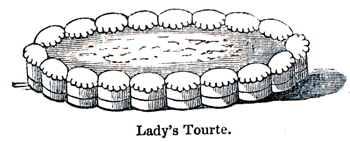
To make this Tourte, which, when filled, is of pretty appearance, two paste-cutters are requisite, one the size, or nearly so, of the inside of the dish in which the entremets is to be served, the other not more than an inch in diameter, and both of them fluted, as will be seen by the engraving. To make the paste for it, throw a small half saltspoonful of salt into half a pound of the finest flour, and break lightly into it four ounces of fresh butter, which should be firm. Make these up smoothly with cold milk or water, of which nearly a quarter of a pint will be sufficient, unless the butter should be very hard, when a spoonful or two more must be added. Roll the paste out as lightly as possible twice or thrice is needful, to blend the butter thoroughly with it, and each time either fold it in three by wrapping the ends over each other, or fold it over and over like a roll pudding. An additional ounce, or even two, of butter can be used for it when very rich pastry is liked, but the tourte will not then retain its form so well. Roll it out evenly to something more than three-quarters of an inch in thickness, and press the large cutter firmly through it; draw away the superfluous paste, and lay the tourte on a lightly floured baking-tin. Roll the remainder of the paste until it is less than a quarter of an inch thick, and stamp out with the smaller cutter—of which the edge should be dipped into hot water, or slightly encrusted with flour— as many rounds as will form the border of the tourte. In placing them upon it, lay the edge of one over the other just sufficiently to give a shell-like appearance to the whole; and with the finger press lightly on the opposite part of the round to make it adhere to the under paste. Next, with a sharp-pointed knife, make an incision very evenly round the inside of the tourte nearly close to the border, but be extremely careful not to cut too deeply into the paste. Bake it in a gentle oven, from twenty to thirty minutes. When it is done, detach the crust from the centre, where it has been marked with the knife, take out part of the crumb, fill the space high with apricot-jam, or with any other choice preserve, set it again for an instant into the oven, and serve it hot or cold. Spikes of blanched almonds, filberts, or pistachio-nuts, may be strewed over the preserve, when they are considered an improvement; and the border of the pastry may be glazed or ornamented to the fancy; but if well made, it will generally please in its quite simple form. It may be converted into a delicious entrée, by filling it either with oysters, or sliced sweetbreads, stewed, and served in thick, rich, white sauce, or béchamel. Lobster also prepared and moulded as for the new lobster patties of page 359, will form a superior dish even to these.
Obs.—Six ounces of flour, and three of butter, will make sufficient paste for this tourte, when it is required only of the usual moderate size. If richer paste be used for it, it must have two or three additional turns or rollings to prevent its losing its form in the oven.
Christmas Tourte à la Châtelaine.—Make the case for this tourte as for the preceding one, and put sufficient mince-meat to fill it handsomely in a jar, cover it very securely with paste, or with two or three folds of thick paper, and bake it gently for half an hour or longer, should the currants, raisins, &c., not be fully tender. Take out the inside of the tourte, heap the hot mince-meat in it, pour a little fresh brandy over; just touch it with a strip of lighted writing-paper at the door of the dining-room, and serve it in a blaze; or if better liked so, serve it very hot without the brandy, and with Devonshire cream as an accompaniment.*
Soft together the flour and salt into a bowl. Add the butter and rub briskly with your fingers (you want to soften the butter not incorporate it completely with the flour, but it must be mixed thoroughly in).
Add enough of the cold water or milk to bring the mixture together as a dough then turn out ono a floured work surface. Roll the dough out to about 1cm thick then take one end and fold it to the centre. Take the other end and fold it over the remainder of the pastry so that you end up with a sandwich of three layers.
Dust with flour and roll out once again. Repeat this folding and rolling process three times in all. After the final folding roll the pastry out to about 2cm thick.
Take a fluted pastry cutter about 12 to 15cm in diameter and use this to cut out a round from the centre of the pastry. Transfer this round to a lightly-floured baking tin. Now take the remaining pastry and roll out to about 6mm thick. Take a 2.5cm pastry cutter and cut out about 16 small rounds from this pastry (enough to go around the outside of the large round).
Brush about 1/3 of the small rounds with water and affix them all the way around the outside of the large round (arrange them so that they stick out from the main pastry, like the petals of a flower). Press down with your thumb on the inner edge of the smaller piece of pastry to make certain it adheres to the larger piece.
Now take a sharp knife with a pointed blade and use this to cut a ring just inside the ring of small rounds you have added. Try to go about half way into the main pastry round and no deeper.
Transfer to an oven pre-heated to 160°C and bake for about 25 minutes, or until the pastry is nicely puffed up and golden brown. Remove from the oven and take out the central piece of pastry (it should be like a giant vol-au-vent. You will have a well in the centre.
Take your mincemeat (enough to completely fill the tourte) and place in a small lidded casserole. Cover with a double layer of kitchen foil then place in the oven alongside your tourte to ensure it is cooked. Alternatively, place the mincemeat in a lidded microwave dish and microwave on full power for 2 minutes then stir and microwave on full power for 2 minutes more. Allow to rest for 5 minutes before use
Fill the well you made in the tourte with your cooked mincemeat. Return to the oven and bake for about 10 minutes. Garnish with the nuts and serve either hot or cold.
For a savoury alternative, mix fish or seafood with a good béchamel sauce and use this to fill the well. For the classic Victorian feel, pour a little brandy in a ladle. Heat this gently over the hob, pour over the tourte, set alight with a split and serve the flaming tart immediately.